AI News
Runway Diffusion-UI: What Happens to a Generated Map When the Route Changes?
Runway Labs’ Diffusion-UI is a research prototype that renders interfaces with a real-time video model. Its map demo links a live route response to generated pixels. That makes it a useful case for examining what should happen when an application’s data changes while the user is looking at a rendered screen.
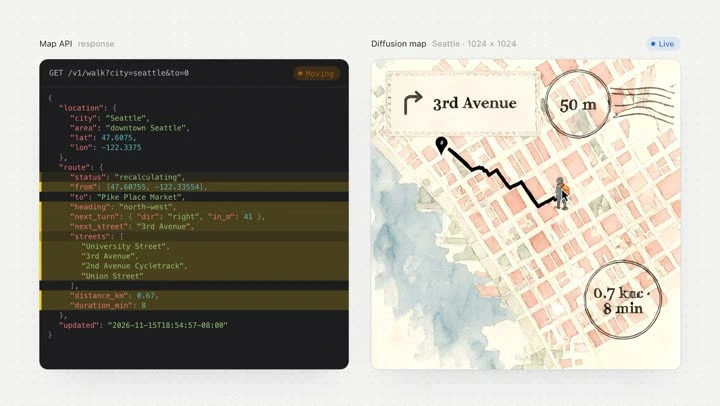
Read the map as two layers
The left panel shows a response with a location and route fields. The right presents those inputs as a route line, a turn label and a remaining-time estimate. A project can change the look of a map while keeping the source data legible alongside it. Runway says this prototype can consume structured data, maintain state and generate its own controls.
This separation matters when the route changes. A navigation app must preserve which route is current and which instruction follows. A developer evaluating a generated view could replay an event that changes the next street, then inspect each visible label and wait to see whether the old one disappears. Counting the time from the data update to the corrected screen would add evidence beyond a static comparison.
Test what happens during a reroute
Use a recorded sequence with a stable route, a recalculation and an updated route. Give each source state a version number and save the rendered output at the same points. Check whether the new street name appears, whether the distance matches the unit shown and whether the old turn label persists after the reroute. Run the same sequence at a narrower width and record whether the relevant controls remain reachable by keyboard. These are proposed evaluation steps. This article examines the public demo, which Runway presents as a research application.
Runway Labs introduced the prototype on November 17, 2026. Runway Labs · Runway Labs’ announcement thread · JoCoding’s recap