Amazon EventBridge Enhanced Custom Bus: Fewer Routing Hops, Shared Operating Risk
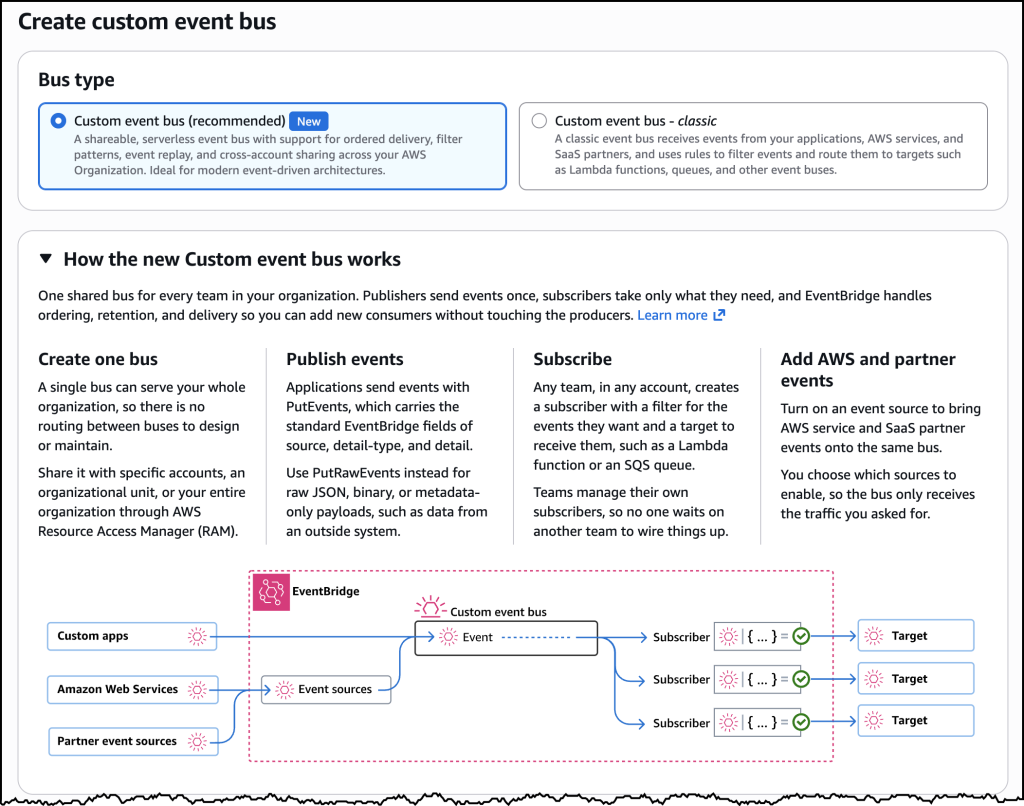
- Direct Sharing vs. Multi-Hop Forwarding: Amazon EventBridge Enhanced Custom Bus allows accounts to share a single centralized event bus directly with consumer accounts, eliminating intermediary forwarding resources and their maintenance burden without proving lower latency.
- Shared Operating Boundary: Consolidating routing hops consolidates operational risk. Because all subscriber accounts connect to a shared event bus, the per-bus ingestion and Subscriber quotas become shared operating boundaries; API throttles retain their own per-account scope.
- Strictly Scoped Ordering: Event ordering is not global across the entire custom bus. Ordering is scoped to each FIFO Subscriber and the publishing account’s EventGroupId. Identical group IDs from different accounts do not create one ordered stream.
- Subscriber-Level Failure Contracts: Each Subscriber needs owned retry, maximum-event-age, timeout, and dead-letter settings. A slow synchronous target can delay later events on its ordered path; isolation across other paths should be tested.
Evidence boundary. AWS documents the shared-bus features and quotas. The larger operating-domain claim is our architectural inference, not an AWS reliability result. The pilot checks below are proposed tests, not measurements performed by Tech Trend Insight.
Amazon EventBridge’s enhanced Custom event bus changes the multi-account design trade-off. Instead of forwarding events through account-local buses, cross-account rules, and bus-to-bus targets, teams can publish to and consume from one bus shared through AWS Resource Access Manager (AWS RAM).
That is a genuine topology simplification. It is not automatically a reliability improvement.
Because Subscribers, traffic, retained history, ordering keys, recovery operations, and billing can converge on one resource, the enhanced bus can also enlarge the domain in which a policy mistake, quota constraint, replay, or downstream failure has consequences. This second point is an architectural inference from the documented sharing and quota model—not a measured AWS reliability result.
AWS announced the enhanced Custom event bus on September 24, 2026. Existing event buses continue as Custom event bus – classic with their existing APIs unchanged; the enhanced bus is a separate, opt-in resource.
What AWS actually launched
The enhanced bus replaces owner-managed rules and targets with consumer-created Subscribers. A Subscriber combines an event filter, one target, retry policy, and dead-letter destination. Consumers can create Subscribers independently, while the bus owner retains control over access to the shared resource.
AWS RAM sharing can grant access to an AWS organization, organizational unit, account, IAM role, or IAM user. Publishers can then send events directly to the shared bus instead of forwarding them through another account’s event bus.
The launch also added:
- ordered delivery selected per Subscriber;
- ordering groups identified by
EventGroupId; - retained events and historical Subscriber start positions;
- configurable retry, maximum-event-age, and dead-letter handling;
- content-based deduplication;
- JSONata transformations;
- deserialization of Apache Avro and Protocol Buffers payloads for JSON-based filtering and routing; and
- synchronous invocation for supported ordered-processing targets, including Lambda.
AWS launched the enhanced bus in 14 Regions: US East (N. Virginia and Ohio), US West (Oregon), Europe (Ireland, Frankfurt, Stockholm, and Spain), and Asia Pacific (Hong Kong, Malaysia, Mumbai, Singapore, Sydney, Thailand, and Tokyo).
The accompanying AWS What’s New announcement states that the bus includes 24 hours of retention and can be extended for up to one year. The current EventBridge quota documentation expresses the configurable range as 1 to 365 days.
Architectural inference: Direct sharing can remove intermediary bus-to-bus routes, but it also causes more accounts to depend on the same bus policy, aggregate quota, Subscriber inventory, retention configuration, and recovery process.
Swipe horizontally to inspect the complete diagram.
Ordering is narrower than “the bus is ordered”
The enhanced bus can serve ordered and unordered consumers at the same time. Publishers assign an EventGroupId; a FIFO Subscriber receives events in publication order within that publisher account’s group. Other Subscribers can receive the same events without ordering. Crucially, two accounts using the same group ID create separate groups, not a shared sequence. See AWS’s ordering documentation.
Within one bus, the practical ordering scope is therefore:
one FIFO Subscriber × one publishing AWS account × one
EventGroupId
It is not a global order across all events on the bus. It also does not turn downstream writes into a distributed transaction.
Consider the three-event lifecycle shown in Figure 3. One order-workflow application, publishing from a single AWS account, sends:
OrderPlacedwhen the order is accepted;OrderPaidafter the application records payment confirmation; andShipmentDispatchedafter it records shipment confirmation.
All three events are published to the same bus, in that sequence, from that same account with EventGroupId=order-42. If separate order, inventory, and delivery accounts instead publish directly, reusing this string does not order their events together. The application must establish any required cross-account business sequence; the shared bus does not infer it.
An order-state Subscriber could request ordered delivery for that group, while an analytics Subscriber consumes the same events without ordering. A later Subscriber could start from a historical position to rebuild a projection from retained events.
These names and flows are synthetic examples, not an AWS reference architecture or a Tech Trend Insight benchmark. The documented semantics support sequencing within one publisher account’s group for each FIFO Subscriber, together with historical start positions; they do not establish global sequencing or exactly-once business effects.
Swipe horizontally to inspect the complete diagram.
The shared limits that matter
The current EventBridge quota page, accessed September 28, 2026, defines several limits that should shape the consolidation boundary.
| Scope | Documented limit | Design implication |
|---|---|---|
| Owned bus | 500,000 events/s; fixed | All shared accounts use one ingestion envelope. |
| Subscriber inventory | 10,000 per owned bus by default; adjustable | Count Subscribers created by every shared account. |
| Event group | 1,500 event-plus-KB units/s; fixed | A hot EventGroupId can hit its own ceiling. |
| Bus retention | 1–365 days | The owner sets the recovery window. |
| Subscriber retries | 0–185 attempts; default 5 | Each consumer sets its failure policy. |
| Maximum event age | 60–86,400 s; default 300 s | A retry can expire before recovery. |
| Synchronous target timeout | 1–30 s; default 30 s | Slow targets can hold an ordered path. |
| Content deduplication | 300 s; fixed | Only matching content in the window is covered. |
| Historical-start concurrency | Limited per bus; value unpublished | Test and confirm capacity before a replay runbook. |
Scroll the table horizontally to read every column.
The event-group formula deserves attention. It is not simply “1,500 events per second.” AWS counts the number of events plus their combined size in KB in each one-second window. Large payloads therefore reduce the number of same-group events that fit below the limit. Groups are scoped to the publishing account: the same EventGroupId in another account is a separate group with its own group limit.
The historical-Subscriber limit is also an evidence boundary: AWS documents that a per-bus concurrency limit exists but does not publish its numeric value on the quota page. Capacity planning should not assume a number that AWS has not stated.
Swipe horizontally to inspect the complete diagram.
Failure handling moves into each Subscriber contract
AWS describes a Subscriber as the unit that combines filtering, target configuration, retry policy, and dead-letter destination. That means a shared bus does not imply one uniform failure policy: each consumer can have a different timeout, retry count, maximum event age, target, and DLQ configuration.
For ordered processing, a slow or failing synchronous target can delay later events in the same ordered path. The quota documentation supports invocation timeouts from 1 to 30 seconds, with a 30-second default, for Lambda, Step Functions, and HTTP targets. AWS has not published a launch-specific latency distribution or an ordered-backlog benchmark.
Content-based deduplication is similarly bounded. AWS says EventBridge hashes meaningful event content and collapses matching events that arrive within five minutes. The launch post describes those matching retries as receiving exactly-once delivery semantics within that mechanism, while also advising applications that already use idempotency tokens to retain them.
That is not a general exactly-once guarantee for downstream side effects. Events outside the 300-second window—or business-equivalent events whose payloads differ—may still reach a consumer. Application-level idempotency therefore remains necessary when duplicate side effects would be harmful.
For observability, AWS recommends combining invocation attempts, successful attempts, retry attempts, permanent failures, DLQ activity, and ingestion-to-success latency rather than relying on a single metric. The EventBridge monitoring guidance specifically warns that undersized or unresponsive targets can cause excessive retries, delivery delays, and permanent failures.
Swipe horizontally to inspect the complete diagram.
Pricing follows payload bytes and delivered copies
AWS describes the enhanced bus as using ingress and egress throughput pricing. A useful comparison with Classic’s per-event ingestion and delivery examples therefore needs a workload-specific estimate of published data, matching Subscriber deliveries, retries, and retained history. At this September 28, 2026 review, the public EventBridge pricing page presents Classic per-event examples but does not expose a verifiable regional enhanced-bus rate card in the material reviewed. We therefore do not transfer Classic rates or claim a dollar total.
Before approving consolidation, obtain the applicable enhanced-bus prices for the deployment Region and configuration from AWS, then compare an observed month of ingress, fan-out, retry traffic, retention, and target-service charges with the existing Classic route.
Swipe horizontally to inspect the complete diagram.
Why fewer hops can mean a larger operating domain
AWS documents the shared resource, shared quotas, consumer-owned Subscribers, and central visibility. It does not claim that every organization should place all events on one bus, nor does it publish comparative incident rates for centralized versus multi-bus deployments.
The broader-risk thesis is therefore an inference with a specific basis:
- Subscriber counts aggregate across shared accounts.
- All event sources consume the same 500,000-events-per-second bus quota.
- Event-group keys have their own fixed ingestion ceiling.
- The bus owner controls sharing and retention configuration.
- Consumers independently configure filters, targets, retries, and recovery positions.
- Historical Subscribers can reprocess retained events, subject to an unpublished concurrency limit.
- Fan-out and retry behavior affect a shared billing model.
None of these facts proves that one shared bus is less reliable. Together, however, they show that consolidation moves several operational decisions into a common boundary. A bus spanning unrelated regulatory, capacity, recovery, or availability requirements should therefore be treated as a deliberate shared platform—not simply as less infrastructure.
An operating contract for consolidation
Before migration, record the existing topology and workload baseline:
- bus-to-bus and cross-account routing hops;
- payload-size distribution and applicable billable units;
- expected Subscriber fan-out;
- retry and permanent-failure rates;
- ordering workarounds;
- retention requirements;
- target-service charges; and
- ownership of policies, alarms, DLQs, and recovery.
Each Subscriber should then have an explicit owner and reviewed configuration covering:
- filter and event contract;
- target and target permission;
- ordered or unordered delivery;
EventGroupIdstrategy;- invocation timeout;
- retry attempts;
- maximum event age;
- dead-letter destination;
- transformation;
- start position;
- expected payload and delivery volume; and
- cost-allocation metadata.
Segmentation should follow failure and governance boundaries. Workloads with incompatible data-access rules, recovery procedures, capacity profiles, or regional requirements do not become good consolidation candidates merely because the enhanced bus can technically host them.
Proposed validation—not testing performed by Tech Trend Insight
Tech Trend Insight has not run the following experiments. They are proposed acceptance checks for a bounded, non-production pilot.
Ordered backlog under slow responses
Publish sequential events to one EventGroupId, then exercise supported synchronous target timeouts at 5, 20, and 30 seconds. Measure delivery latency for later events in that group, retry behavior, DLQ outcomes, and isolation from other groups.
The timeout values fall within the documented 1–30-second range. The expected latency distribution remains open because AWS has not published an ordered-backlog benchmark.
Historical-start concurrency
Create multiple Subscribers from past positions in a test account and record where CreateSubscriber first returns LimitExceededException. Confirm the applicable per-bus limit with AWS before defining a recovery runbook because the public quota page does not provide its numeric value.
Deduplication boundary
Send identical payloads inside and outside the 300-second window, followed by semantically equivalent events with changed JSON content. Compare broker suppression with an idempotent consumer’s records. The goal is to distinguish content-based deduplication from business-level duplicate detection.
Workload-specific cost model
Model one month using real payload-size distribution, applicable billable units, Subscriber fan-out, retry egress, retention, and any Classic routing hops that would disappear. Verify the live enhanced-bus rate card and configured retry policy before estimating a total.
Bounded migration
Dual-publish one noncritical event class and compare permissions, ordering, recovery, observability, and cost attribution before moving additional domains. Existing Classic buses remain supported, so rollback does not require an all-at-once conversion.
Decision rule: consolidate only where the boundary is operable
Adopt the enhanced Custom event bus when all three conditions hold:
- The topology benefit is material. Cross-account forwarding duplication, ordered consumption, or retained recovery solves a real problem.
- The shared boundary is governable. Bus ownership, Subscriber contracts, quota alarms, policy review, idempotency, DLQs, and replay authorization are defined.
- The workload economics are favorable. Payload distribution, applicable billable units, fan-out, retries, retention, and removed Classic hops have been modeled with actual traffic.
If any condition fails, retaining Custom event bus – classic or using multiple enhanced buses remains defensible. AWS supports coexistence and describes the enhanced bus as a new resource that customers can adopt at their own pace.
The verified evidence supports fewer routing resources and stronger broker-level ordering, recovery, transformation, and deduplication options. It does not yet support a claim that centralized deployments are universally cheaper, faster, or more reliable.
Frequently Asked Questions (FAQ)
What changes with the enhanced Custom Event Bus, and does Classic always need an intermediate bus?
The enhanced Custom Event Bus can be shared through AWS RAM, with each consumer account creating and owning its own Subscribers. A Subscriber brings together filtering, a target, and delivery settings. This can remove forwarding resources from an existing bus-to-bus design. However, Classic does not always require an intermediate bus: it already supports direct cross-account delivery to certain AWS services in the same Region. The comparison here is with a multi-bus forwarding topology, not every possible Classic deployment. Fewer routing resources alone do not establish lower cost or latency for your workload. See AWS’s Custom Event Bus overview and supported cross-account targets.
Can different accounts use the same EventGroupId to create one ordered stream?
No. Ordering applies within an event group for a Subscriber configured for FIFO delivery, and the group is scoped to the publishing AWS account. Two accounts publishing to the same bus with EventGroupId=order-42 create separate groups; their events are not ordered relative to one another. Within one bus, the useful scope is FIFO Subscriber × publishing account × EventGroupId. To illustrate one ordered stream, all events in the example must be published from the same account into the same group. This is a delivery-order guarantee, not proof of business causality or an atomic transaction across downstream systems. See AWS’s ordering and deduplication documentation.
How should a team estimate the cost of a shared enhanced bus?
AWS describes ingress and egress throughput pricing: publishers pay for ingestion and subscribers pay for delivered events. A workload estimate also needs the applicable retention, optional evaluation, and target-service charges. Do not apply Classic’s 64 KB per-event examples to the enhanced bus without confirming its billing rules. Use the deployment Region’s current rates and actual payload sizes, matched deliveries, and retry behavior; compare those costs with the existing route, including any forwarding resources that would disappear. This article does not provide a verified regional rate card or a dollar-saving estimate. See the EventBridge pricing page and Custom Event Bus documentation.
What happens when a Subscriber’s target fails, and what does a DLQ protect?
Delivery failures are retried until a configured attempt or event-age limit is reached. If an on-failure SQS destination is configured and permissions allow delivery, EventBridge writes a failure record there; without a DLQ, exhausted events are dropped. DLQ delivery can itself fail, so monitor that outcome too. A FIFO Subscriber’s failing event delays later events in its own group while other groups can continue. A DLQ is therefore a recovery aid, not a guarantee that shared quotas, target dependencies, or policy mistakes cannot affect other consumers. Review each Subscriber’s retry policy, event age, target timeout, delivery permissions, and recovery procedure. See retry and DLQ behavior and Enhanced-bus monitoring.
Official Sources
- AWS News Blog: Introducing enhanced custom event buses in Amazon EventBridge — September 24, 2026
- AWS What’s New: Amazon EventBridge relaunches event buses for enterprise scale — September 24, 2026
- Amazon EventBridge quotas — accessed September 28, 2026
- Amazon EventBridge Custom and Classic event-bus documentation — accessed September 27, 2026
- Subscribing to events on a Custom Event Bus — accessed September 28, 2026
- Amazon EventBridge pricing — accessed September 28, 2026
- Best practices for monitoring EventBridge event delivery — accessed September 27, 2026

