Gemini 3.8 Flash: Google’s New Workhorse for Long-Horizon AI Agents
Google introduced Gemini 3.8 Flash and Gemini 3.8 Flash Cyber on September 2, 2026. The announcement positions Flash as a faster, lower-cost model for long-running agent workflows, coding, and multi-step reasoning.
 Gemini 3.8 Flash and Gemini 3.8 Flash Cyber. Source: Google.
What changed in Gemini 3.8 Flash?
Google describes 3.8 Flash as its strongest reasoning and coding model in the Flash family while keeping the speed and low-cost profile associated with Gemini 3.7 Flash. The introductory API price is $0.75 per million input tokens and $3.75 per million output tokens. That makes the model interesting for applications that need many calls, repeated tool use, or a steady stream of code reviews.
The bigger change is how the model handles work that takes time. Google says Gemini 3.8 Flash is tuned for agentic workflows, long-horizon software engineering, and tasks that require several decisions before a useful answer appears. In practice, that means an agent can inspect files, call tools, test a change, and return to the problem with more context.
Long-horizon coding is the main story
On Google’s reported evaluations, Gemini 3.8 Flash reaches 54.9% on HLE-Verified and performs strongly on DeepSWE v1.1, a benchmark for long-horizon software engineering. The results are company-reported measurements, so they should be read as a signal rather than a universal ranking. Still, the direction is clear: Google is focusing on useful work completed over many steps, not only short benchmark answers.
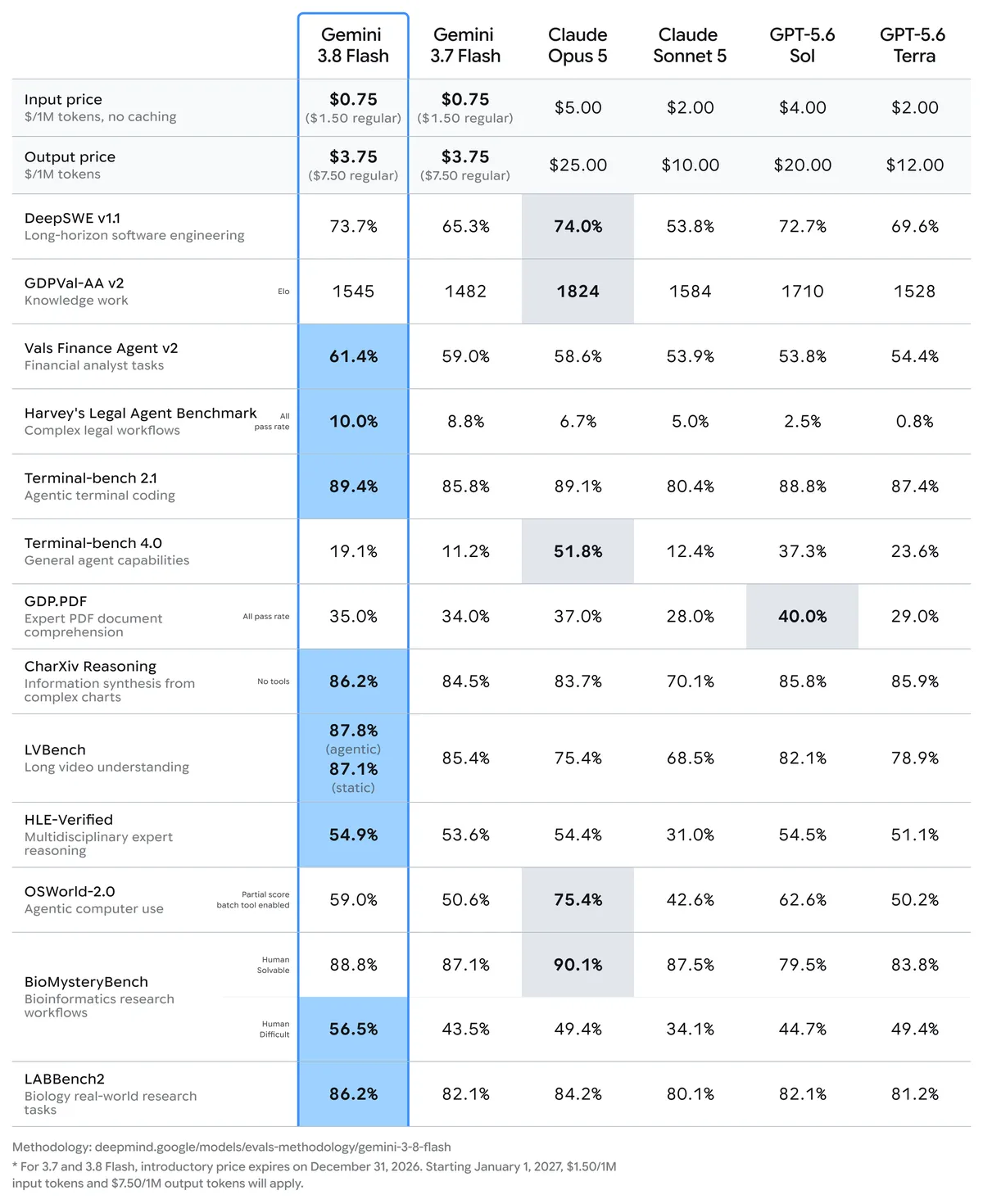 Google’s comparison table. Source: Google.
A small developer example shows the intended style of use:
This is only a starting point. Production agents still need checkpoints, tests, and human review before they change a real repository.
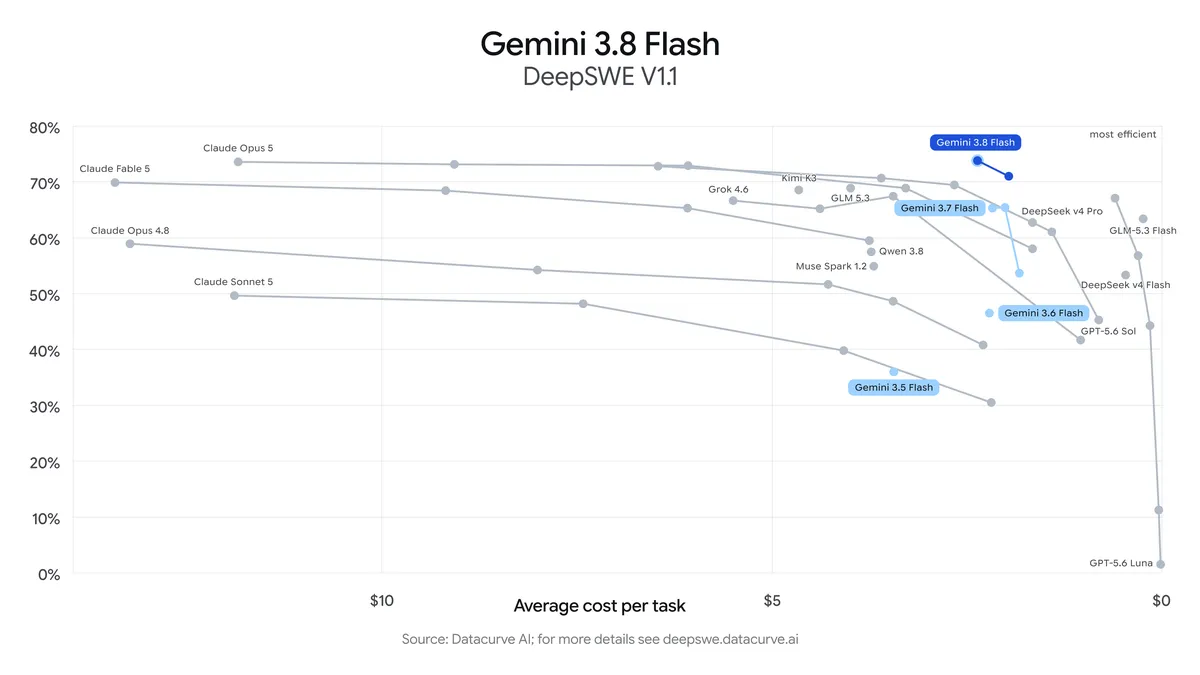 DeepSWE v1.1 results reported by Google. Source: Google.
Gemini 3.8 Flash Cyber
The Cyber version is aimed at trusted defenders. Google says it reached frontier-level performance on CyberGym, found real-world vulnerabilities with more than 70% success in its internal evaluation, and scored 47.2% pass@1 on CWE-Bench patching. Google also reports that its Chrome security team produced 2.6 times more correct patches with 3.8 Flash Cyber than with the best much larger commercial models in that internal comparison.
Those capabilities come with stronger safeguards. Google says the model is available through its Fairwind Program for vetted defenders, while cyber-offense and CBRN protections remain part of the safety design.
The token tradeoff
Reasoning-heavy work can require extra thinking steps and tool calls. Google notes that higher effort settings may consume more tokens, while lower effort levels reduce token overhead. This is useful operationally: use higher effort for difficult debugging and long plans, then choose a lower setting for routine classification or short answers. Gemini 3.7 Flash remains available when efficiency is the priority.
Our take
Gemini 3.8 Flash looks less like a flashy chatbot update and more like an attempt to make AI agents dependable at the middle layer of real work: inspect, reason, edit, test, and explain. The low introductory price makes that workflow easier to experiment with, but the benchmark claims still need independent testing. The best first use is a bounded task with clear checkpoints, where speed, cost, and the quality of the final result can all be measured.
Official source: Google’s Gemini 3.8 Flash announcement.


