Code Lab
ZONOS3-Mini Explained: Browser TTS, Voice Controls and Local Inference
CODE LAB · PROJECT SPOTLIGHT
ZONOS3-Mini TypeScript · MIT code / Apache 2.0 weights
Browser-local TTS, an actual Korean generation and the output-stage source.
Preview: Zyphra/ZONOS3-Mini on GitHub · release availability checked separately below.
ZONOS3-Mini turns written text into speech, with local browser and native-runtime options. We tried the official browser demo with a supplied Korean voice and obtained one downloadable 7.2-second WAV. That is a concrete setup-and-generation result, not a general verdict on voice quality.
Zyphra’s November 9 announcement describes an efficient speech model with 100 million active parameters and 800 million total parameters. The distinction matters: active compute per step is not the same as the complete weight set or the memory required by the whole application.
What we actually checked in the browser
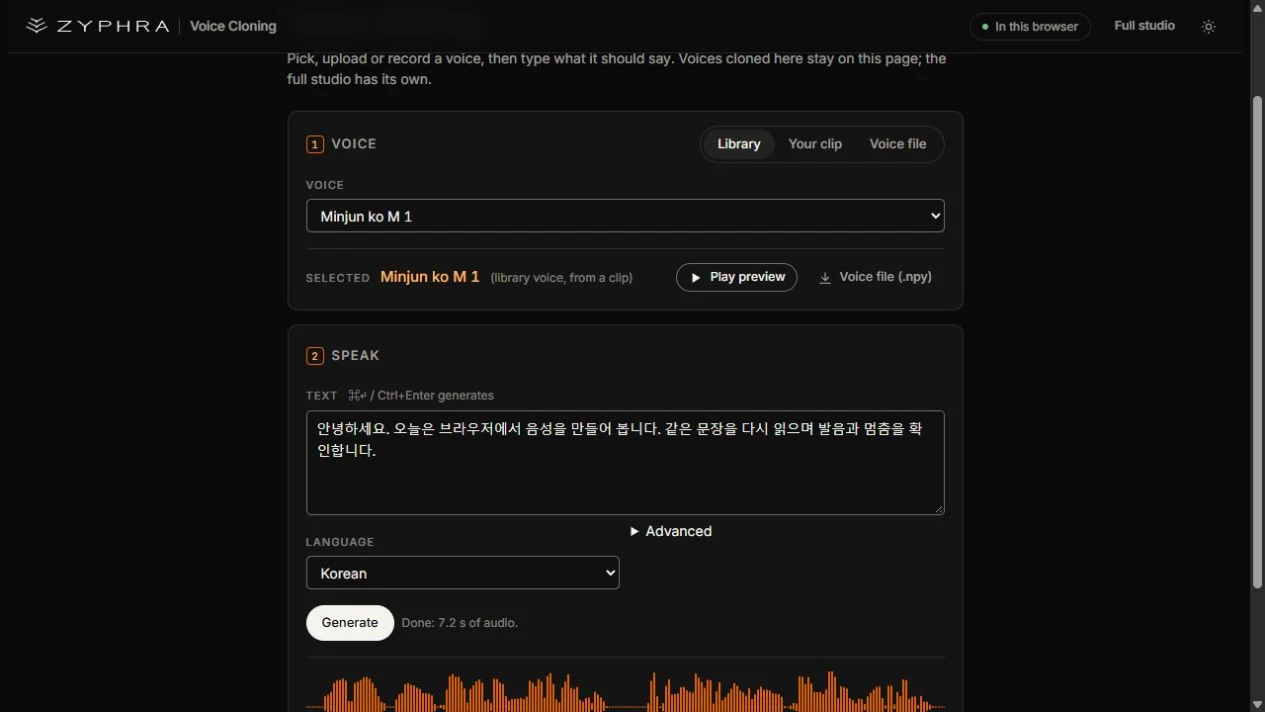
We opened the official Lite page, which downloaded its voice model and audio codec before exposing the controls. The backend badge identified execution as In this browser. We selected the built-in Minjun ko M 1 voice and Korean, entered the following original text and pressed Generate:
안녕하세요. 오늘은 브라우저에서 음성을 만들어 봅니다. 같은 문장을 다시 읽으며 발음과 멈춤을 확인합니다.The text means: “Hello. Today we are making speech in the browser. We read the same sentence again to check pronunciation and pauses.” That is what the input asks for; it is not a transcript independently recovered from the generated audio.
| Recorded item | Observed value |
|---|---|
| Voice / language | Minjun ko M 1 / Korean |
| Result shown in the interface | Done: 7.2 s of audio |
| Downloaded WAV | 44,100 Hz · mono · 16-bit PCM |
| File-derived duration | 317,520 samples ÷ 44,100 Hz = 7.2 seconds |
| Seed recorded with the download | 1957142802 |
| What this establishes | The selected browser route produced a readable audio file from that input. |
We did not record wall-clock generation time, run a multi-device comparison or grade pronunciation through a listening study. Seven-point-two seconds is the output’s duration, not time to first audio or inference latency. Only one trial is reported, and it used a library voice rather than a new voice clone.
You can repeat the workflow on the official Lite demo ↗. A browser demo does not eliminate hardware requirements: this route needs WebGPU support, first-run model downloads and enough resources for the model. Browser or GPU differences can change whether it works.
Choose the backend that matches your machine
| Backend | Project-documented route | What to check |
|---|---|---|
| Browser WebGPU | The public local playground; no application server to install | Browser support, initial download and device resources. |
| NVIDIA / CUDA | Linux x86_64 server; README notes H100 testing | Toolkit and dependency requirements; do not infer identical behavior on every consumer GPU. |
| Apple Silicon / MLX | Separate MLX server | Use its own environment and instructions. |
| ggml / C++ | CPU, CUDA, Metal or Vulkan routes | Build tools and matching model formats. |
The native README and model card describe several serving integrations. Pick one complete route rather than mixing commands from different runtimes. The project notes that some first starts compile kernels and download weights, so the first run and a cached run are different observations. Pinned runtime README ↗
What the publisher’s performance chart does—and does not—show
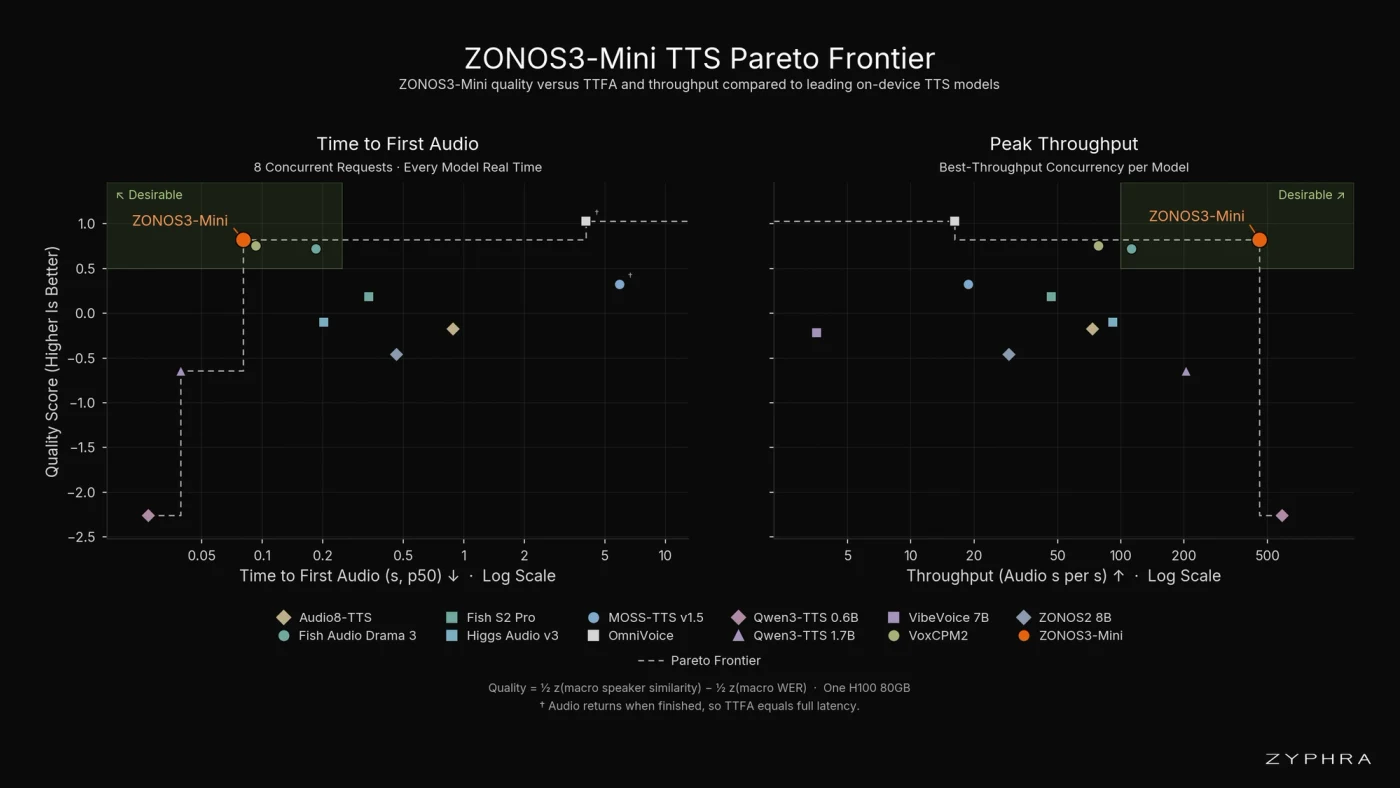
Time to first audio and throughput answer different questions. The first concerns how quickly playback can begin; the second concerns how much audio the system can produce over time. A quick initial sound does not guarantee a smooth long sentence, and a high throughput figure does not describe every device’s startup behavior.
For a narration workflow, also check names, numbers, punctuation, repeated lines and consistency across takes. Compare one setting at a time with the text fixed. Our short trial does not establish the best voice or a reliable speed ranking.
Inside the source: applying gain without a hard jump at the limit
The browser runtime’s outputPcm function is a small, readable part of the path from decoded audio to output samples. This is actual TypeScript from servers/web/src/output.ts.
The function creates a new sample buffer and applies the requested gain. Samples below a threshold pass through, while larger magnitudes follow a tanh-based soft-limiting curve. The sign is preserved. This is output-level handling; it does not correct a mispronounced word or establish that the speaker sounds natural.
The file’s comment explains why processing streamed chunks can agree with processing a complete array: the operation acts sample by sample. That is a specific implementation property, not a claim that every streaming stage is identical.
Code and model licenses are different
The inspected runtime repository uses the MIT License. The model card identifies the weights as Apache 2.0. Keep those scopes separate when redistributing a runtime, model files or a modified package; also check the rights attached to any reference recordings.
Source excerpt credit and MIT license notice
MIT License

Copyright (c) 2026 Zyphra, Inc.

Permission is hereby granted, free of charge, to any person obtaining a copy
of this software and associated documentation files (the "Software"), to deal
in the Software without restriction, including without limitation the rights
to use, copy, modify, merge, publish, distribute, sublicense, and/or sell
copies of the Software, and to permit persons to whom the Software is
furnished to do so, subject to the following conditions:

The above copyright notice and this permission notice shall be included in all
copies or substantial portions of the Software.

THE SOFTWARE IS PROVIDED "AS IS", WITHOUT WARRANTY OF ANY KIND, EXPRESS OR
IMPLIED, INCLUDING BUT NOT LIMITED TO THE WARRANTIES OF MERCHANTABILITY,
FITNESS FOR A PARTICULAR PURPOSE AND NONINFRINGEMENT. IN NO EVENT SHALL THE
AUTHORS OR COPYRIGHT HOLDERS BE LIABLE FOR ANY CLAIM, DAMAGES OR OTHER
LIABILITY, WHETHER IN AN ACTION OF CONTRACT, TORT OR OTHERWISE, ARISING FROM,
OUT OF OR IN CONNECTION WITH THE SOFTWARE OR THE USE OR OTHER DEALINGS IN THE
SOFTWARE.
For the model’s language list, weight formats and deployment alternatives, use the official model card ↗. For a different audio task, ACE Music v1’s lyrics-to-song workflow explains generating music rather than spoken narration.
Reviewed November 16, 2026. Discovery lead: JoCoding’s edited briefing ↗. Source excerpt pinned above. One local-browser generation and WAV metadata inspection were performed; publisher benchmarks remain publisher results.
Discussion