AI News
Weight-Space Programming: A Targeted Model Repair Behind the Big Headline
Reading neural weights like code is a striking research direction. The strongest interpretation starts with the specific failure that was repaired and the conditions of the experiment.
What the authors demonstrated
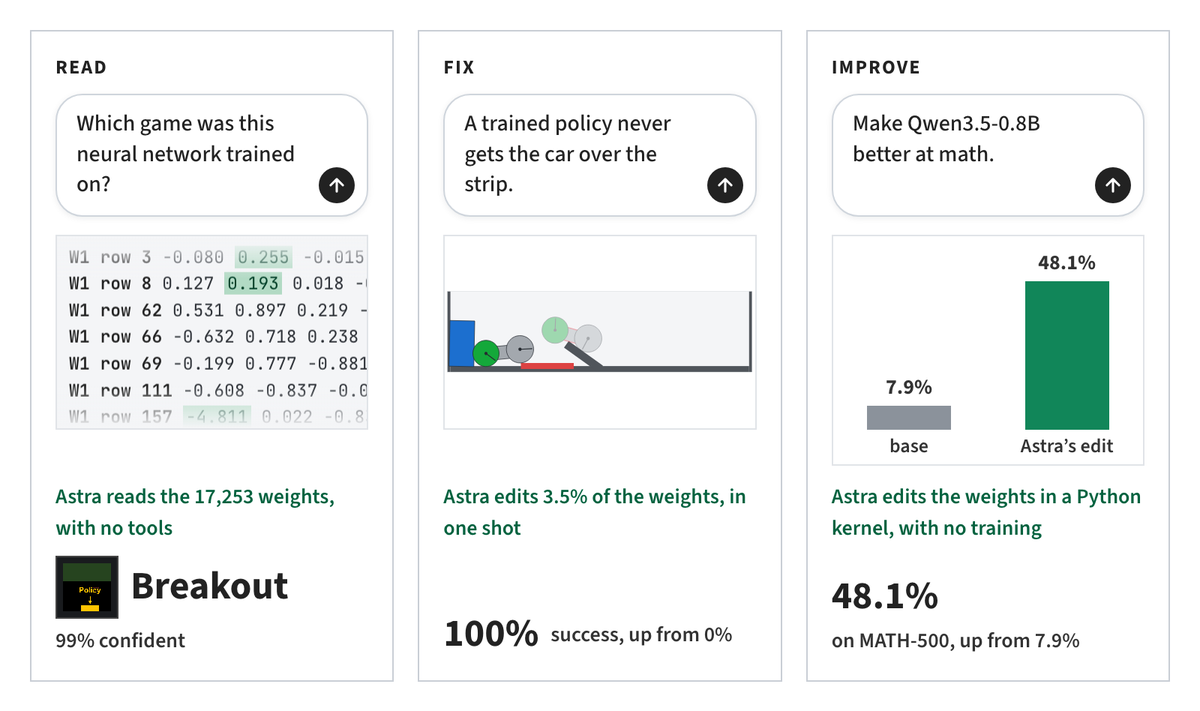
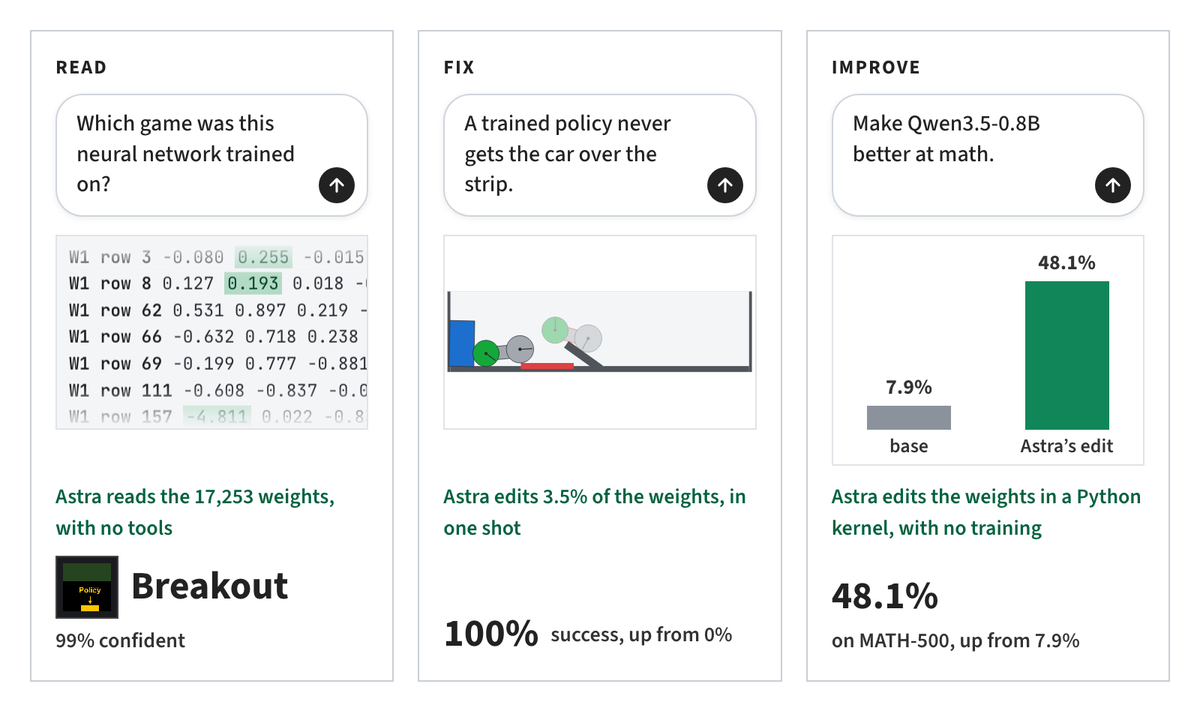
In a November 2 post, MIT CSAIL researchers describe GPT-6 Astra inspecting and writing neural-network weights without gradient-based training loops. Their experiments include identifying small game networks and editing a Qwen3.5-0.8B checkpoint to reduce a known reasoning-loop problem. They report editing 0.016% of its weights, raising MATH-500 from 7.9% to 48.1% under the same sampling settings.
Where the claim stops
The authors present early experiments, not a general replacement for model training. Their limitations include difficulty extending results to larger networks and an unsuccessful attempt to improve Gemma mathematics performance. Editing another model’s parameters is also a different claim from an AI independently improving its own frontier capabilities.
What to check before drawing conclusions
Our proposed review asks for the original checkpoint, edited tensors, evaluation settings and failures on unrelated tasks. Fixing one bottleneck can improve several scores without creating a general new learning algorithm. Treat the headline numbers as author-reported until a reproduction checks both the gain and possible regressions. We reviewed the published report and separately attempted the public live demo described below.
Our live demo attempt: blocked before either answer
We opened the Hugging Face comparison linked by the researchers on November 15 and ran its default problem with the default 4,096-token cap. The problem asks for x² + y² when x + y = 20 and xy = 91; the checkable answer is 400 − 182 = 218.
Both output panels returned a hardware-limit message: the requested 450-second GPU duration exceeded the Space’s allowance. Neither model produced an answer in our attempt. This is an availability failure, not evidence for or against the weight edit’s accuracy. The demo’s recorded verification runs are previous runs supplied by its maintainer, not our own results.
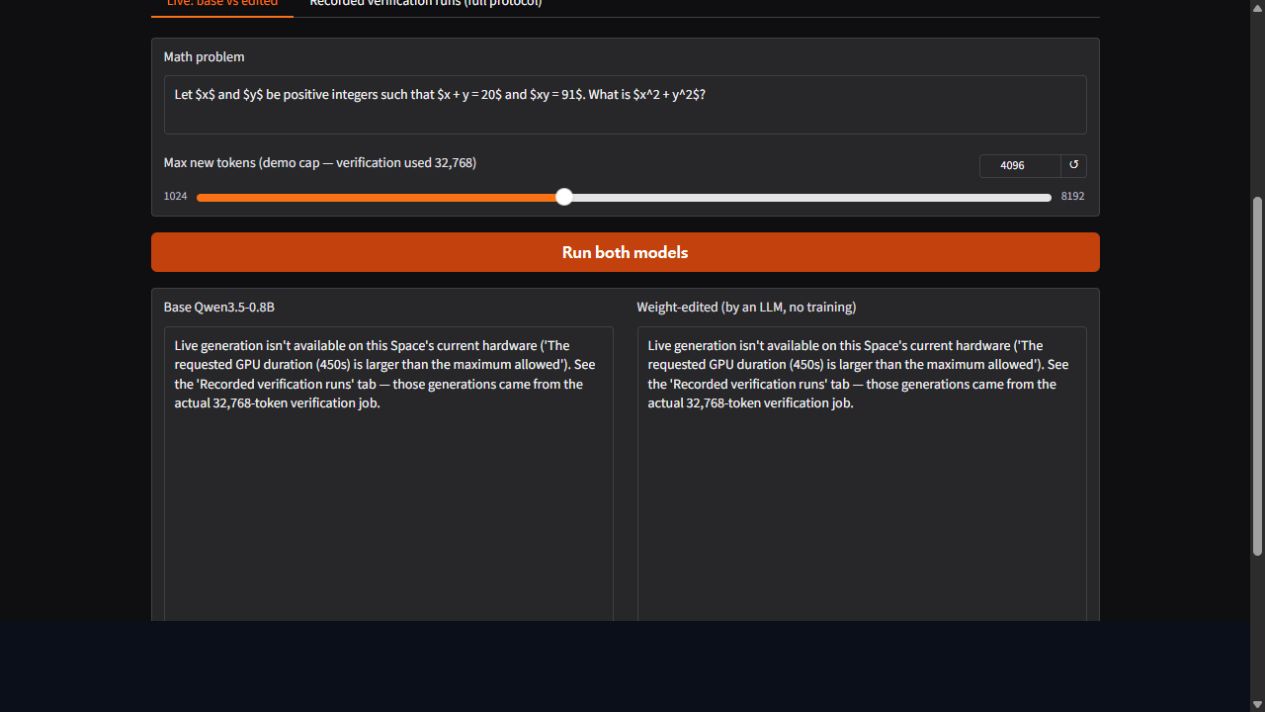
Practical takeaway: check the demo’s current hardware and whether you are viewing live output or recorded runs before treating a screenshot as a fresh reproduction. We did not reproduce the full MATH-500 protocol.
What changes when the weights change?
| Approach | Where the change lives | What a useful check asks |
|---|---|---|
| Prompt or retrieved note | The context supplied for a run | Does the answer depend on a note that can be inspected and updated? |
| Checkpoint edit | The model’s numerical parameters | Which tensors changed, and what happens on unrelated tasks? |
| Gradient-based training | Parameters updated through an optimization procedure | What data, loss and evaluation protocol produced the update? |
These distinctions explain why the result is interesting without making it a universal training recipe. If a model has a specific tendency to repeat itself, removing that bottleneck may let it finish reasoning it previously failed to complete. The important question then becomes whether the edit repairs that behavior reliably or trades it for a different failure.
Keep the demonstrations separate
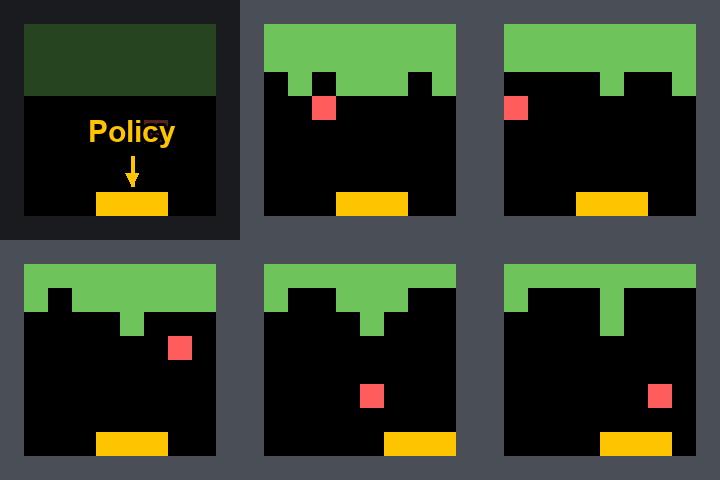
Recognizing a small game network, writing a game policy and repairing a language-model checkpoint ask different things of the method. A compact game can make the idea visually understandable, but that animation does not validate a mathematics benchmark. Likewise, an improved math score does not establish general competence at editing arbitrary neural networks.
For a closer audit, the researchers publish experiment logs, and the edited checkpoint’s model card provides an artifact to inspect. Start by matching the model version and generation settings to the reported evaluation. Then check a separate set of problems and tasks that were not the target of the repair.
Our demo failure also illustrates a practical reporting rule: preserve a failed run. Replacing it with a maintainer’s successful recording would hide an availability problem and imply a reproduction that never happened. The screenshot above tells a prospective tester what blocked our attempt; the linked research artifacts tell them where a fuller reproduction would begin.
Read the source: Rikiya Takehi, Jayden Teoh, Alex Zhang and Omar Khattab · MIT CSAIL · How METR measures research acceleration.
Reviewed November 15, 2026. Discovery credit: JoCoding’s November 8 IT NEWS briefing. This brief independently checks the linked primary source and distinguishes the announcement date from this article’s publication date.
Discussion