Code Lab
Flash ALOHA Explained: Why Faster Robot Learning Starts With Better Demonstrations
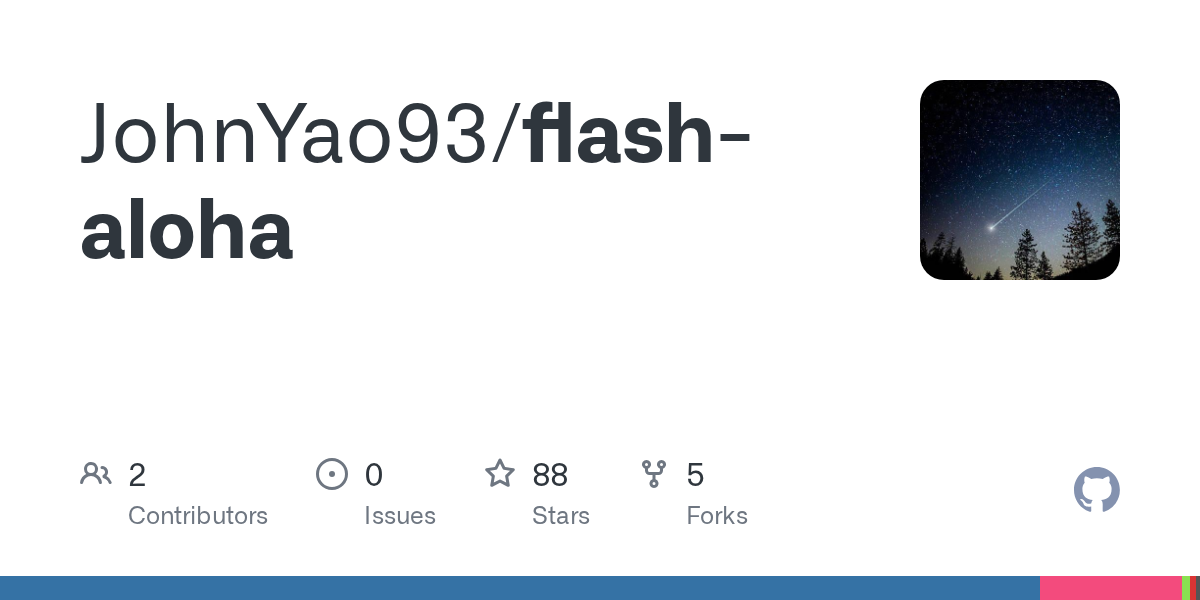
CODE LAB · PROJECT SPOTLIGHT
Flash ALOHA Python · MIT
Follow hand-guided robot learning, creator demonstrations and the source behind execution timing.
Preview: GitHub / JohnYao93/flash-aloha · checked November 15, 2026
Flash ALOHA asks a practical robotics question: how can a robot learn a fast movement if collecting the demonstration slows the person down? Its answer combines hand-guided recording with a learning and execution pipeline designed around accurate motion.
The project is by John Hua Yao, Qi Wu, Yihuai Gao, Chelsea Finn and Zipeng Fu. Its official page says the work was first presented as ALOHA Lightning at ICRA in July 2026. We are examining the public project and source in November; that is not a claim that the research first appeared today.
Start with the actual robot demonstrations
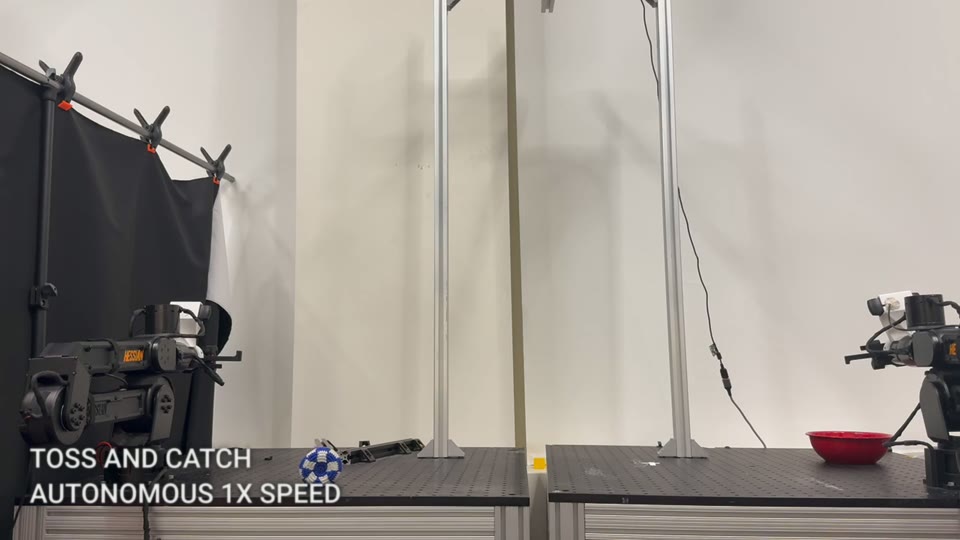
A catch is a useful example because completing the right pose eventually is not enough. The gripper must be in the right place at the right time. A slow demonstration or an inaccurate record of the hand’s path can remove the very timing the policy needs to learn.
The researchers use a backdrivable platform that a person can guide directly. Their paper connects this recording method to a lightweight smoothing approach and visual masking of the operator. Those are distinct interventions: collecting better trajectories addresses motion data, while masking addresses the mismatch between a person guiding the robot during recording and an empty workspace during autonomous execution.
What “50 demonstrations” does and does not mean
The authors report results on specified tasks using 50 demonstrations per task, with success rates above 80% near human speed. The tasks include tossing and catching, folding shorts, battery insertion and clearing a table. These are reported research results, not a promise that any robot will learn any task from fifty examples.
Explore two more creator-published task scenes
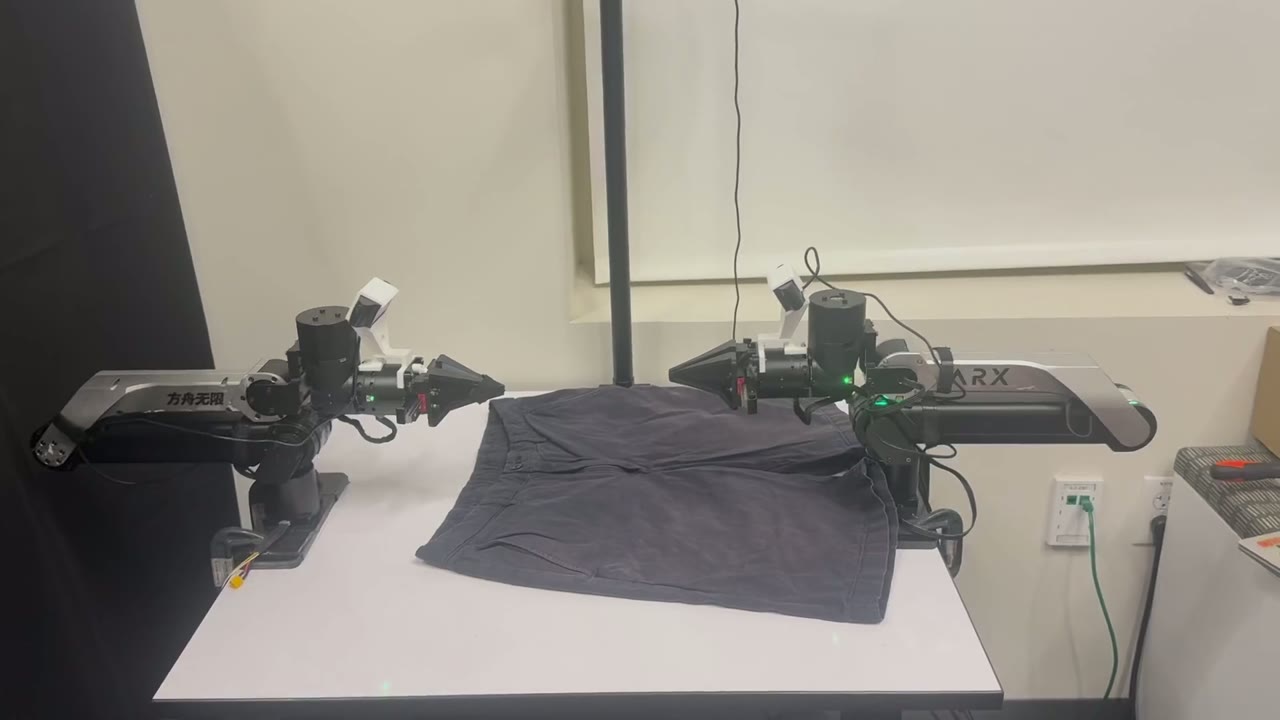
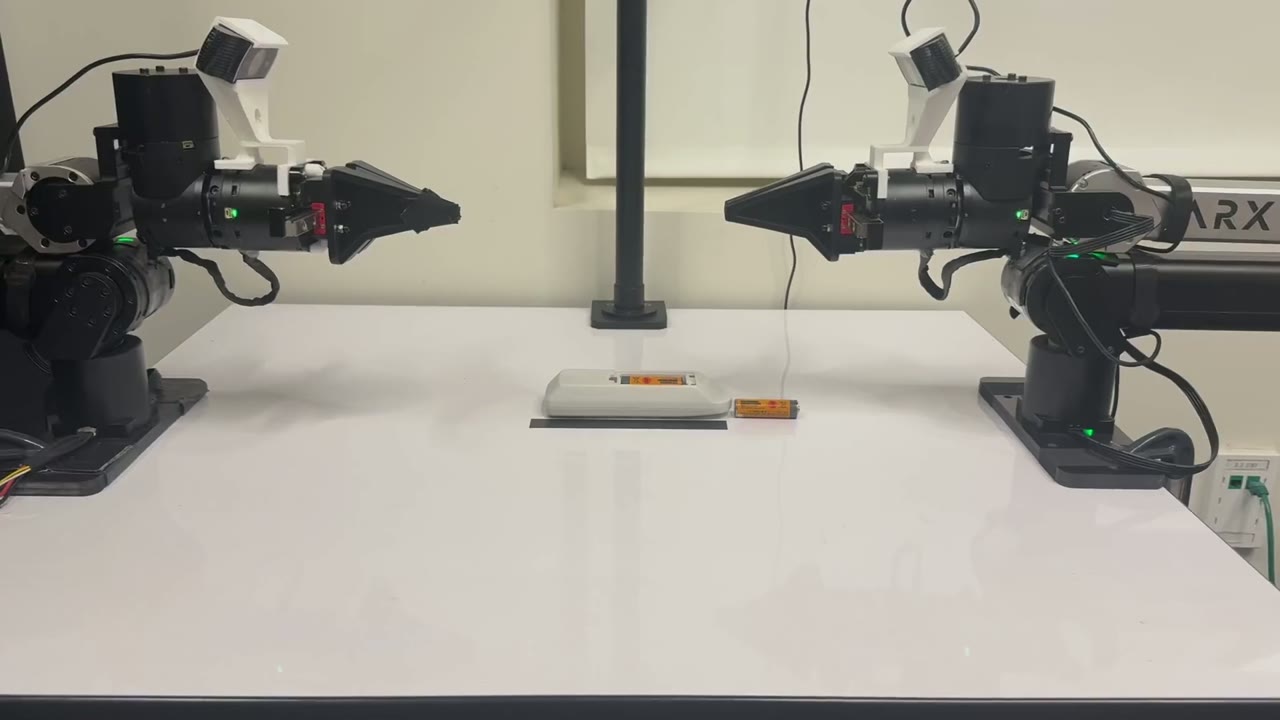
For a reader comparing systems, the missing context is often as important as the headline number. Ask how success was defined, how many evaluation attempts were made, which starting conditions varied and what happened in failures. A controller that succeeds on one calibrated workbench has not automatically demonstrated transfer to a different arm, camera placement or object.
Watch the original motion demonstrations and explore the tracking-error analysis on the project page ↗. Videos remain on the creator’s page rather than playing inside this article.
Actual source: budget for inference before the next motion
The repository contains recording, training, inference and calibration code. The following short excerpt concerns an execution constraint in the asynchronous policy path. It checks whether the configured overlap represents enough time to cover the allowed inference delay. It is not the complete smoothing algorithm or the implementation of a learned grasp.
The calculation is readable without running a robot. overlap_steps / fps converts a number of control steps into seconds. max_delay_ms / 1000 converts the allowed inference delay into the same unit. The function rejects configurations where the overlap is equal to or smaller than that delay.
Arithmetic example, not a hardware test: at 50 control steps per second, an overlap of 10 steps represents 0.2 seconds. A configured maximum delay of 150 ms is smaller than that window; 200 ms is equal and therefore rejected by the comparison shown. This demonstrates what the guard checks, not that a robot will remain safe or achieve the paper’s success rate.
That distinction matters in fast motion. A policy response can be structurally valid yet arrive too late for a planned execution window. A timing guard makes a violated assumption explicit. It does not measure every physical delay, guarantee a successful catch or replace the rest of the controller.
Actual source: src/inference/policy_chunks.py, lines 362–370, pinned to commit aec35bb. Text is unchanged apart from highlighting and line numbers. Repository source is MIT-licensed; retain the following notice when reusing it.
Source credit and MIT license notice
MIT License

Copyright (c) 2026 John Yao

Permission is hereby granted, free of charge, to any person obtaining a copy
of this software and associated documentation files (the "Software"), to deal
in the Software without restriction, including without limitation the rights
to use, copy, modify, merge, publish, distribute, sublicense, and/or sell
copies of the Software, and to permit persons to whom the Software is
furnished to do so, subject to the following conditions:

The above copyright notice and this permission notice shall be included in all
copies or substantial portions of the Software.

THE SOFTWARE IS PROVIDED "AS IS", WITHOUT WARRANTY OF ANY KIND, EXPRESS OR
IMPLIED, INCLUDING BUT NOT LIMITED TO THE WARRANTIES OF MERCHANTABILITY,
FITNESS FOR A PARTICULAR PURPOSE AND NONINFRINGEMENT. IN NO EVENT SHALL THE
AUTHORS OR COPYRIGHT HOLDERS BE LIABLE FOR ANY CLAIM, DAMAGES OR OTHER
LIABILITY, WHETHER IN AN ACTION OF CONTRACT, TORT OR OTHERWISE, ARISING FROM,
OUT OF OR IN CONNECTION WITH THE SOFTWARE OR THE USE OR OTHER DEALINGS IN THE
SOFTWARE.
What the setup actually requires
The reviewed README describes ARX L5 and Trossen_L5 arms, camera servers and calibration. Its default ACT policy and Flow option have different implementation paths; remote inference can also use an OpenPI server. Decide which path you intend to inspect before assuming a command applies to every configuration.
The project selects Python 3.10. Physical use requires the ARX SDK and native dependencies on the robot computer, plus calibration for the actual arms and cameras. Repository calibration files are examples from one setup. Copying those files is not a substitute for measuring your own geometry.
| What you want to inspect | Useful starting point | Limit |
|---|---|---|
| Architecture and configuration | README, task YAMLs and the inference modules. | Reading source does not validate physical behavior. |
| Hardware-free checks | The documented offline tests with simulated hardware. | Passing them would not reproduce a real robot experiment. |
| Physical reproduction | Hardware guide, arm bring-up and calibration documentation. | Requires equipment, suitable compute and an operator-controlled setup. |
Source availability does not make the robot free: arms, cameras, computation and assembly still have costs. We have not priced a complete matching build. The release page should also be checked before expecting a packaged application; this article pins source rather than inventing a versioned installer. The MIT source license does not by itself grant rights to unrelated media or erase third-party notices.
What this project is useful for learning
Flash ALOHA connects a visible result to several engineering layers: the recording interface, visual preparation, learned policy and timing of execution. That makes it a stronger Code Lab subject than a single impressive catch. Follow one assumption across those layers and ask where the code checks it, where the experiment measures it and where uncertainty remains.
For a contrasting local-software workflow, our AWS Emulator article shows a bounded API check that can run without physical equipment. Here, the boundary is different: source inspection and a hardware-free test can explain components, while the robot result still belongs to the researchers’ documented experiment.
Official references: Project and demonstrations · Repository · Paper · README at reviewed commit · License.
Reviewed November 15, 2026. Discovery lead: JoCoding’s November 15 IT NEWS briefing. We read the available transcript and independently checked the primary sources. The robot scenes are supplied by the project authors. We inspected the pinned source; we did not operate a robot, train a policy or reproduce the reported physical trials. GitHub preview statistics are a dated image, not a live trend ranking.