AI News
Gemini 4 Hydrogen: Choosing Speed for Everyday Agent Work
Gemini 4 Hydrogen is Google’s execution-focused model for everyday coding and agent work. Its practical appeal is not simply a high score: it is the possibility of finishing routine steps quickly while preserving a clear path to deeper reasoning when a task becomes difficult.
Scope: Product rollout and API access vary by surface
Read the official announcement ↗
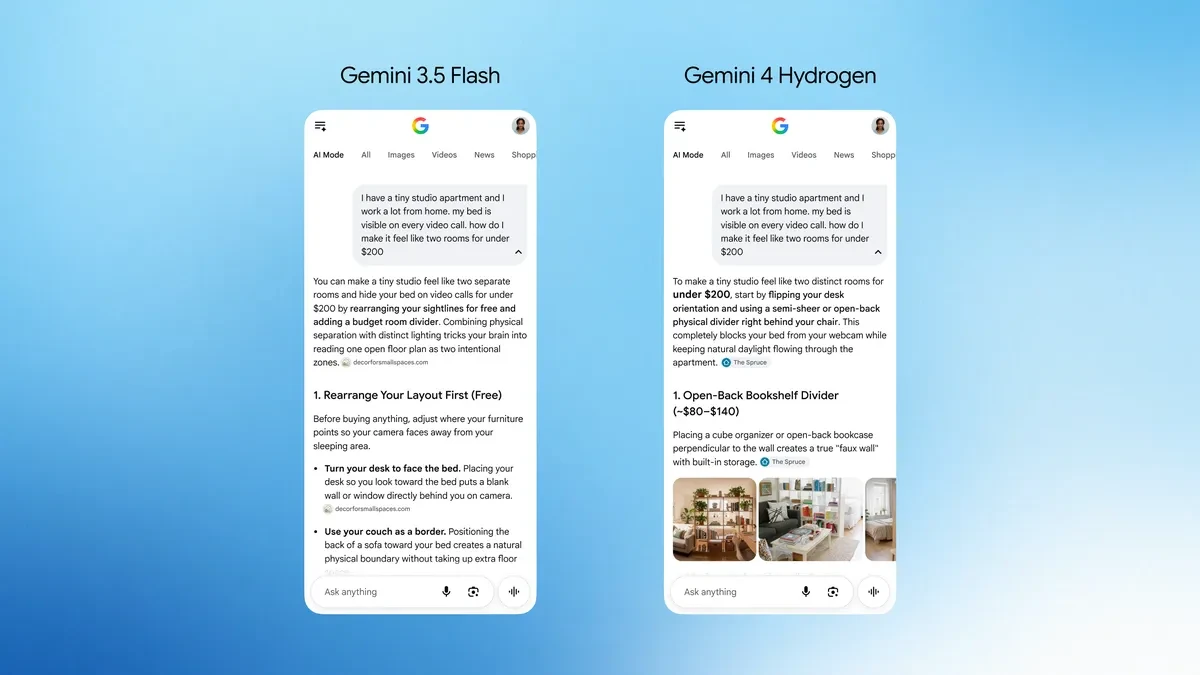
Look at how the answer handles the constraint
The apartment example includes a budget and a concrete goal: separating a work area from a bed visible on calls. A useful response should preserve both. A visually richer answer is helpful only if its suggestions fit the room, the budget and the actual problem.
This gives readers a better evaluation question than “Which answer looks smarter?” Identify the constraints first, then check whether the result respects them. A response that adds a costly partition after being given a small budget has missed the task even if the recommendation is attractive.
Execution speed matters across a whole loop
Google positions Hydrogen for rapid execution and describes collaboration with Carbon and Argon in multi-model workflows. The announcement also describes four thinking levels: low, medium, high and xhigh. Those controls suggest a workflow choice rather than one setting that is best for everything.
Consider a fictional request to fix a date parser. Reading the relevant file, changing a small branch and running an existing regression are execution steps. Deciding how a system should handle ambiguous dates across time zones is a deeper design question. A fast model is most useful when the surrounding workflow recognizes that boundary rather than racing through an unclear requirement.
| Stage | Useful evidence | When to pause |
|---|---|---|
| Understand the request | A concrete input, expected output and relevant constraint. | The examples disagree about the intended behavior. |
| Make the change | A small diff tied to the failure. | The proposed edit expands into unrelated modules. |
| Verify it | The original regression plus nearby cases. | A passing check does not cover the changed assumption. |
| Escalate | A bounded question with the evidence already gathered. | Another model would receive the same missing requirements. |
Another official example: a place recommendation
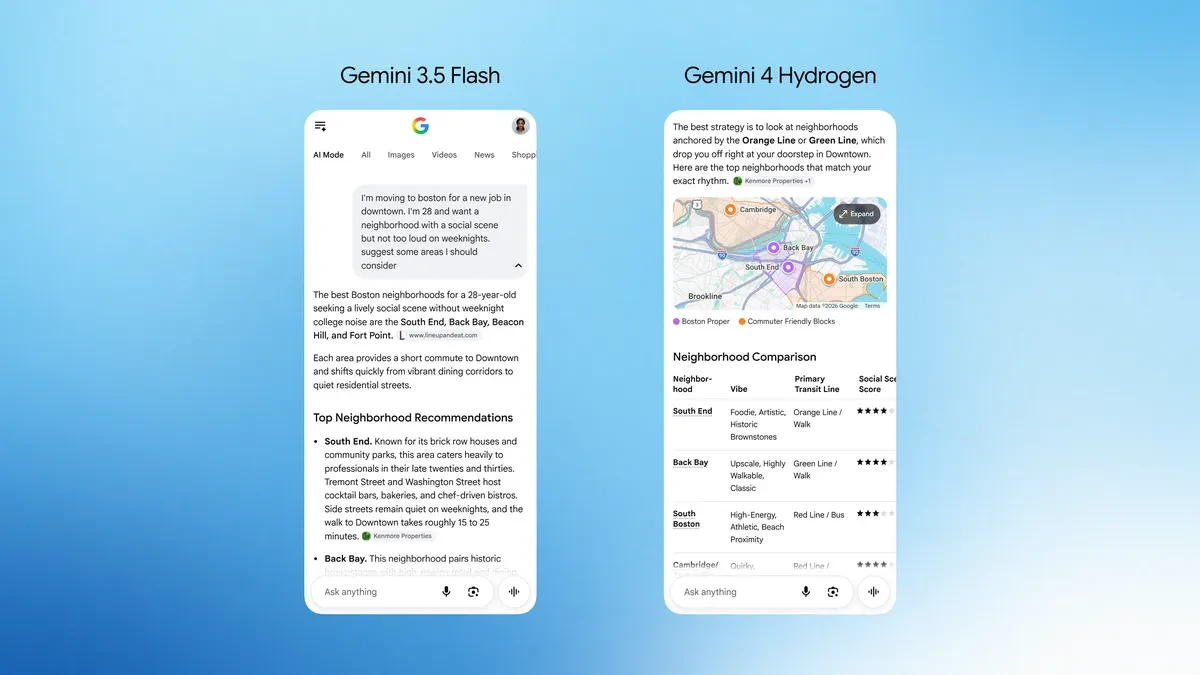
Location questions make grounding important. A concise answer may omit a decisive constraint, while a long one can hide a stale or unsuitable recommendation. Inspect the sources and the user’s requirements, not just the amount of visible detail. A model upgrade does not remove the need for current information about a place.
The screenshots are also specific to a product surface. Search presentation, the Gemini app and a direct API call are not interchangeable experiments. Record the product, exact model and settings whenever you compare outputs; otherwise, a changed interface or tool configuration can be mistaken for a model difference.
Read the cost alongside the amount of work
The launch post lists Hydrogen at $1.50 per million input tokens and $7.50 per million output tokens. A hypothetical uncached request using 100,000 input tokens and 10,000 output tokens would therefore cost $0.225 at those rates, before other services or pricing adjustments. This is arithmetic, not a bill from our account.
A cheaper individual request can still create a more expensive task if it causes extra retries or longer review. Keep a ledger of successful completion, tool calls, output volume and human corrections. Compare the cost of the accepted result, rather than the first draft alone.
Check the exact access path
Google links a Hydrogen entry in AI Studio and a model card. Account eligibility, quotas and product-specific settings should be checked there before planning a deployment. An app displaying a new model name does not establish that every API integration or organization has the same access.
The announcement’s benchmark and orchestration improvements are Google’s reported results. They are useful leads for evaluation, not a speed guarantee on a reader’s repository. We did not run those benchmarks or verify performance with a live API session.
A useful first comparison
Use a small existing regression, keep the starting files identical and define the acceptance checks before seeing the output. Record the thinking setting as well as the result. A failed attempt belongs in the comparison. For the other side of the escalation decision, our Fable 5.2 explainer discusses assigning a stronger model a bounded technical problem rather than every routine step.
Reviewed November 15, 2026. Discovery lead: JoCoding’s November 15 IT NEWS briefing. Product claims were checked against primary sources. Images are Google’s official examples. No independent model ranking or hands-on speed claim is made here.