AI News
Fish Audio Live 3: Why Listening While Speaking Changes Voice Agents
A voice agent can answer quickly and still interrupt at the wrong moment. Fish Audio Live 3 targets that second problem: listening while speaking, acknowledging a caller without taking over and yielding when the person actually wants to change the conversation.
Scope: Full-duplex voice service; official launch specifies English support
Read the official announcement ↗
Three behaviors that should not be confused
A brief acknowledgment, a pause inside a sentence and an interruption carry different meanings. A caller saying “right” may be inviting the agent to continue. A caller saying “wait, change that” is asking for the floor. Treating both as an interruption can make a service frustrating; ignoring both can make it impossible to correct an order.
Fish Audio’s launch material centers on those distinctions. Its examples include callers pausing while supplying information and revising requests mid-conversation. The useful question for a prospective deployment is whether the completed task preserves the correction, not whether the voice alone sounds natural.
The architecture separates conversation from the agent’s work
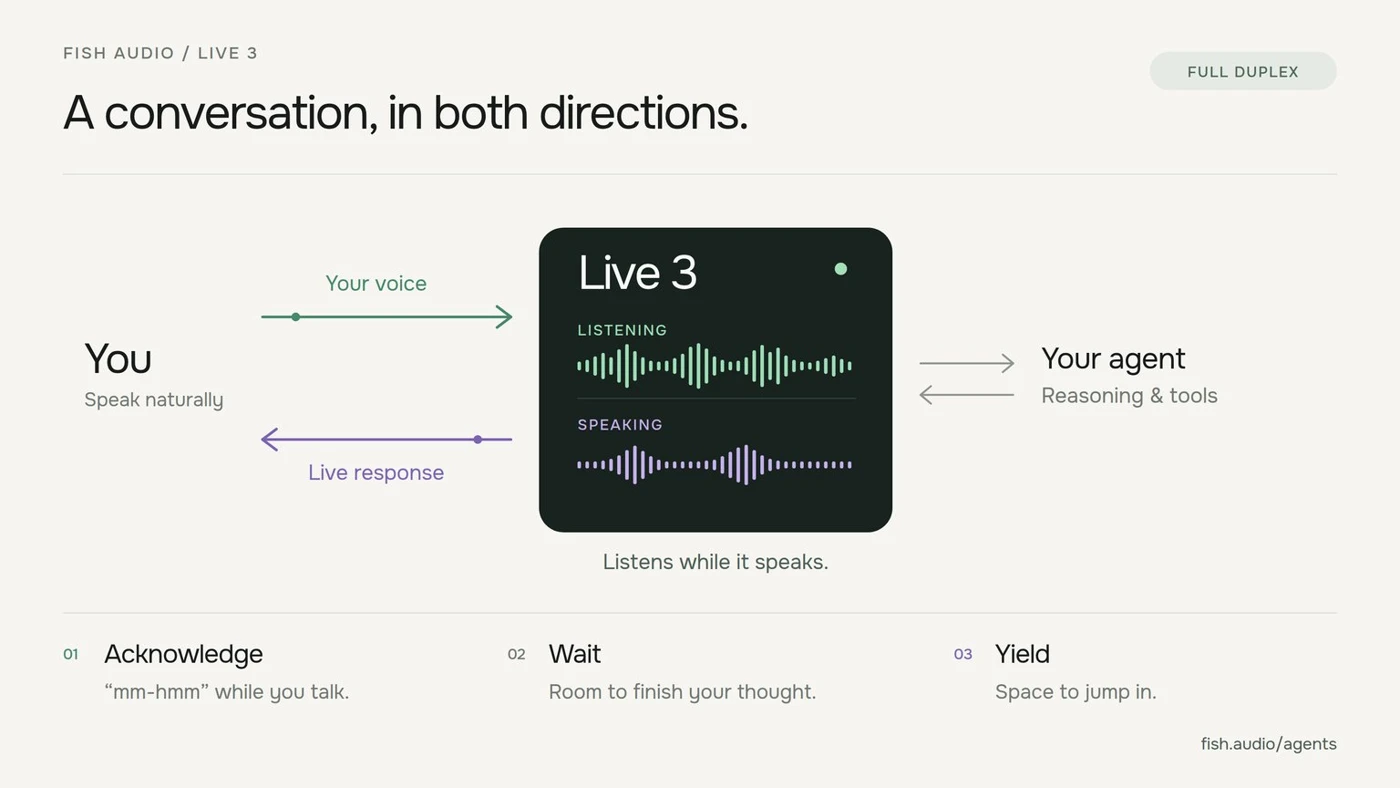
Read the diagram in both directions. The person’s speech goes into the conversational component while its responses return to the caller. The agent’s reasoning and tools sit on the other side. This explains why better turn-taking does not itself establish that an order, booking or account change was completed correctly.
For example, a restaurant agent might correctly hear a change from two meals to three, then fail to update the cart. A pleasant acknowledgment would conceal a task failure. Keep the final item list and the system’s action result available for review rather than judging the exchange only by its rhythm.
Use a test that distinguishes listening from agreeing
Proposed exercise, not a call we ran: use a fictional order with one quantity change, one brief acknowledgment and one pause while recalling a detail. Ask the agent to read back the final order before any action. The order should contain the corrected quantity and should not interpret an encouraging “yes” during an explanation as a new purchase instruction.
| Conversation event | Behavior to inspect | Result to check |
|---|---|---|
| A short acknowledgment | The agent can continue without restarting needlessly. | No duplicated or lost item. |
| A pause inside a detail | It leaves room for the person to finish. | The complete value survives in the final record. |
| An explicit correction | It yields and incorporates the new request. | The superseded quantity or date is removed. |
| A tool cannot complete the action | It describes the incomplete result accurately. | No claim that an unconfirmed order was placed. |
Use the same script across several attempts and retain failures. Change the speaker, background noise or connection conditions one at a time so the cause of a difference is easier to identify. A clean demonstration clip is useful for hearing the intended behavior, but it cannot represent every caller’s environment.
Language support is a material limit
The official announcement says Live 3 speaks English at launch. We therefore do not present a Korean demonstration mentioned in a broader video briefing as verified support for this exact release. A service may offer multiple voice products; evidence for one should not silently become evidence for another.
Live 3 is described as available through the Fish Agent Platform and API, with enterprise on-premises deployment also mentioned. That is not a public open-weight download. Check the actual account access, integration terms and usage price before planning a production trial. A free signup button does not establish that every agent call is free.
Latency needs a definition
Fish Audio reports very short reaction times in its launch description. A quick acknowledgment and a completed answer are different measurements, as are model reaction time and a caller’s end-to-end network experience. When evaluating a system, record the timing of the behavior you actually care about: yielding, completing a correction or returning a tool-confirmed result.
Transcription quality also remains a separate question. Our Scribe v3 explainer examines words, speaker labels and live turns. A voice workflow may need evidence for all three even when the conversation sounds smooth.
Hear the original examples externally
The official Live 3 post contains the test-call excerpts ↗. Listen for what happens immediately after a pause or correction, then compare it with the final confirmed task. Audio remains on the publisher’s page; this article uses static visual explanations.
Reviewed November 15, 2026. Discovery lead: JoCoding’s November 15 IT NEWS briefing. Product claims were checked against primary sources. The visuals are supplied by Fish Audio. We did not place a live call, measure latency or confirm support beyond the official launch description.