Code Lab
PaperOrchestra Explained: From Research Materials to a LaTeX Manuscript
CODE LAB · PROJECT SPOTLIGHT
PaperOrchestra Python · Apache 2.0
Trace research materials through an outline, literature workflow and LaTeX draft.
Repository preview/artwork: google-research/paper-orchestra · creator-supplied image.
PaperOrchestra is a research framework for turning pre-writing materials into a structured LaTeX manuscript. Inputs include an idea, experimental logs and a target template—not merely a topic that can stand in for completed research.
The google-research repository credits Google Cloud AI Research authors and explicitly says this is not an officially supported Google product. The associated preprint was submitted on April 6, 2026. A new Short discussing it does not make it a new November product launch.
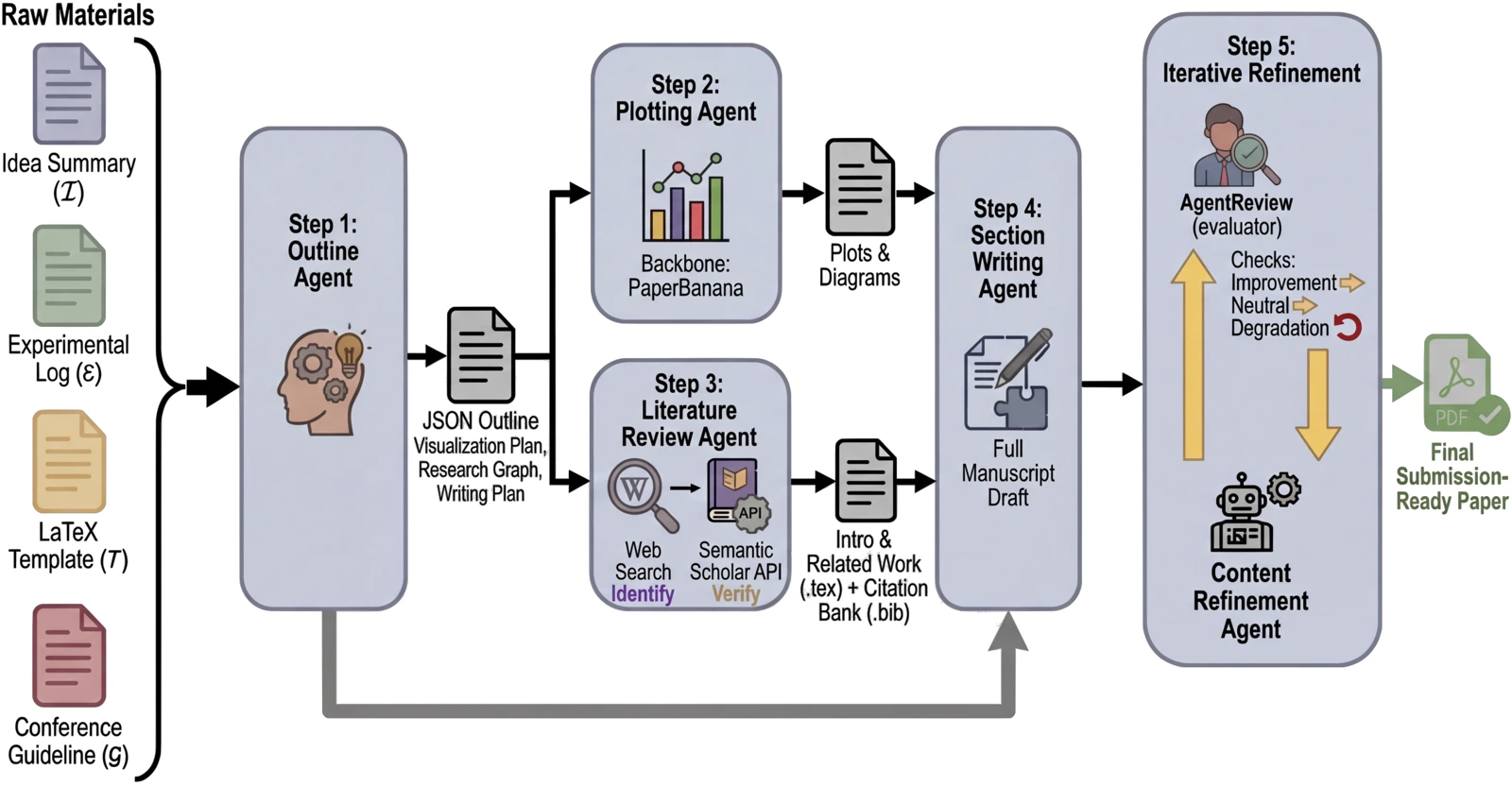
Separate writing tasks from research evidence
An outline establishes structure, literature review retrieves and synthesizes related work, section writing turns materials into prose, and refinement reviews the draft. Plotting is a configurable route, not permission to invent results.
| Material | Role | Researcher’s check |
|---|---|---|
| Idea and scope | Defines the question and contribution | Does the claimed contribution follow from work actually performed? |
| Experimental log | Supplies methods, settings and observations | Can numbers and claims be traced to records? |
| Literature | Provides related work and citations | Does each source exist and support the statement? |
| Figures | Communicates results or concepts | Do plots match real data, and are conceptual diagrams labeled? |
| Template | Shapes the LaTeX output | Formatting is distinct from scientific acceptance. |
The project’s “submission-ready” wording describes its intended manuscript artifact. It does not establish novelty, correct experiments, verified references, author approval or acceptance by a conference.
Prepare inputs before launching the pipeline
The setup example uses Python 3.11 in a Conda environment and installs requirements.txt. It documents credentials for the model providers you select and a Semantic Scholar key for the relevant literature integration. Account access, quotas and costs depend on that route.
The Python CLI supplies separate raw-material, template and output directories:
python paper_writing_cli.py \
  --raw_materials_dir /path/to/research-materials \
  --latex_template_dir /path/to/latex-template \
  --output_dir /path/to/output \
  --use_plotting false
Replace these example paths with your materials. Check the expected idea and experimental-log files before running. The plotting flag is explicit here so the selected route is visible. With plotting disabled, the CLI warns about missing supplied figures; enabling plotting chooses a different writer path.
Use the pinned README ↗ and Streamlit guide ↗ for the complete setup. We did not run either interface or submit unpublished research to a provider.
Inside the source: required inputs are explicit
The argument parser requires raw_materials_dir and latex_template_dir, while output_dir is optional. These are interface checks: they tell the program where to look. They do not validate the experimental evidence or determine whether the requested template is appropriate.
Later code prepares an output workspace and selects the plotting or non-plotting writer. Preserve input materials separately from generated prose so that claims can be traced back to evidence rather than treating the draft itself as evidence.
Actual source: Copyright 2026 Google LLC, google-research/paper-orchestra at the linked commit. Apache License 2.0; original line numbers and syntax coloring added. Repository license ↗
Research evaluation is not a writing guarantee
The PaperOrchestra preprint ↗ describes a manuscript-writing benchmark and human comparisons with automated systems. Those evaluate a particular research setup. We have not reproduced the benchmark or assessed the scientific correctness of a generated paper.
The README says the dataset used for paper generation is not included and will be released separately. At this check, the latest-release endpoint did not expose a published release package. This walkthrough pins a source commit and does not promise a complete evaluation reproduction from one download.
Do not mix similarly named implementations
The discovery video also links a separate Ar9av/PaperOrchestra implementation. Installation methods, model access and licensing should not be transferred between repositories because they share a research name. This article covers google-research/paper-orchestra, its Apache 2.0 code and its provider-based setup.
Keep the final review grounded
Check the outline against the real question. Verify references at their sources, audit numerical claims against experiment records and rebuild plots from underlying data where possible. Inspect the compiled manuscript for missing citations, inconsistent notation and misleading captions.
Our Plannotator guide provides context for structured human feedback on a plan or document. That is a workflow connection, not a claimed native integration.
Explore the research repository ↗ and release availability ↗. We inspected public materials and source; no manuscript generation, compilation or evaluation reproduction was performed.
Reviewed November 17, 2026. Discovery lead: Mindung’s Short ↗. Primary documentation and source checked independently. Creator diagram and pinned source only; no scientific validation or hands-on writing result is claimed.