AI Technical Articles
GPT-Live-1.1 API: How WebRTC Standby Changes Voice Session Costs
OpenAI listed GPT-Live-1.1 in its API changelog on November 19, 2026. It is a full-duplex voice model, meaning it can receive speech while it is speaking. OpenAI reports improvements in multilingual pronunciation, accent consistency and transcription. WebRTC standby is available for both GPT-Live-1.1 and GPT-Live-1. It can reduce the cost of silence without closing the call.

How standby affects a live call
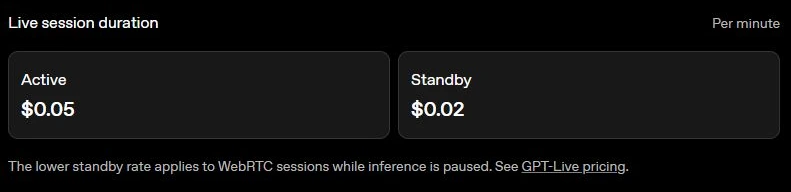
Standby waits for a configured idle period from 5 to 60 seconds. Inference then pauses while the WebRTC session stays connected. When a participant speaks, inference resumes. OpenAI lists active voice time at $0.05 per minute and standby time at $0.02 per minute. Backend model and tool charges are separate. Check your actual session usage and the account’s concurrent-session limit before drawing conclusions about operating cost.
Estimate from measured usage
If usage reports six active minutes and four standby minutes, the voice portion is $0.38 at the documented rates. Ten active minutes would cost $0.50. The example assumes four minutes already counted as standby, after any qualifying idle period.
from decimal import Decimal
active = Decimal("6")
standby = Decimal("4")
voice_cost = active * Decimal("0.05") + standby * Decimal("0.02")
assert voice_cost == Decimal("0.38")
Price the pauses in a real call pattern
Imagine two ten-minute support calls. Each caller spends two minutes looking up an order number. One goes quiet for two consecutive minutes. The other pauses for twenty seconds on six occasions. With a fifteen-second idle threshold, each break has its own waiting period before standby can begin. The distribution of silence changes the estimate even though the total time on the call is identical.
from decimal import Decimal

def estimate(call_seconds, pauses, threshold):
    standby = sum(max(0, pause - threshold) for pause in pauses)
    active = call_seconds - standby
    cost = (active * Decimal("0.05") + standby * Decimal("0.02")) / 60
    return standby, cost

for pauses in ([120], [20] * 6):
    seconds, cost = estimate(600, pauses, threshold=15)
    print(f"{len(pauses)} pause(s) | {seconds:3} s standby | USD {cost:.4f}")
In the single long pause, 105 seconds qualify. In the six short pauses, only 30 qualify. At the rates above, that gives $0.4475 and $0.4850 for the voice portion. The example treats each pause as a separate, fully idle interval and assumes an immediate transition at the threshold. A microphone recording alone cannot establish when inference paused. Compare this estimate with the service-reported usage from the same call before using it in a budget.
Test what happens when the user returns
Use a synthetic customer reference, such as an alphanumeric case number. Say it once, pause beyond the configured threshold, then interrupt a later spoken reply with a correction. Record the active and standby time, whether the first words after the pause were captured, and whether the final reference reflects the correction. An open connection confirms the call stayed connected. The corrected reference and timing tell you how the conversation recovered.
Run the same scripted sequence with standby disabled and use the same model, client and microphone. Log any delegated backend call separately. This article uses the product documentation and a sample cost calculation. It does not report paid API calls or measured audio results.
Also see the GPT-Live API guide and OpenAI’s developer announcement.
For a local full-duplex alternative, see our Haru 4B setup guide.