AI Technical Articles
GR00T 2 Explained: What Five Robot Demonstrations Actually Teach
Five demonstrations matter only after asking what the robot already learned and how the test tasks were chosen. NVIDIA’s GR00T 2 is a useful advance in adapting prior learning, but its headline result needs both conditions attached.
NVIDIA introduced GR00T 2 on November 9, 2026. In its selected 50-task experiment, average trial success rose from 40% without target-task demonstrations to 71% with one and 95% with five. The key qualification: those tasks were chosen because they could already reach at least 80% success after five demonstrations. Here is how the model learns, what that test measures, and what a developer can check next.
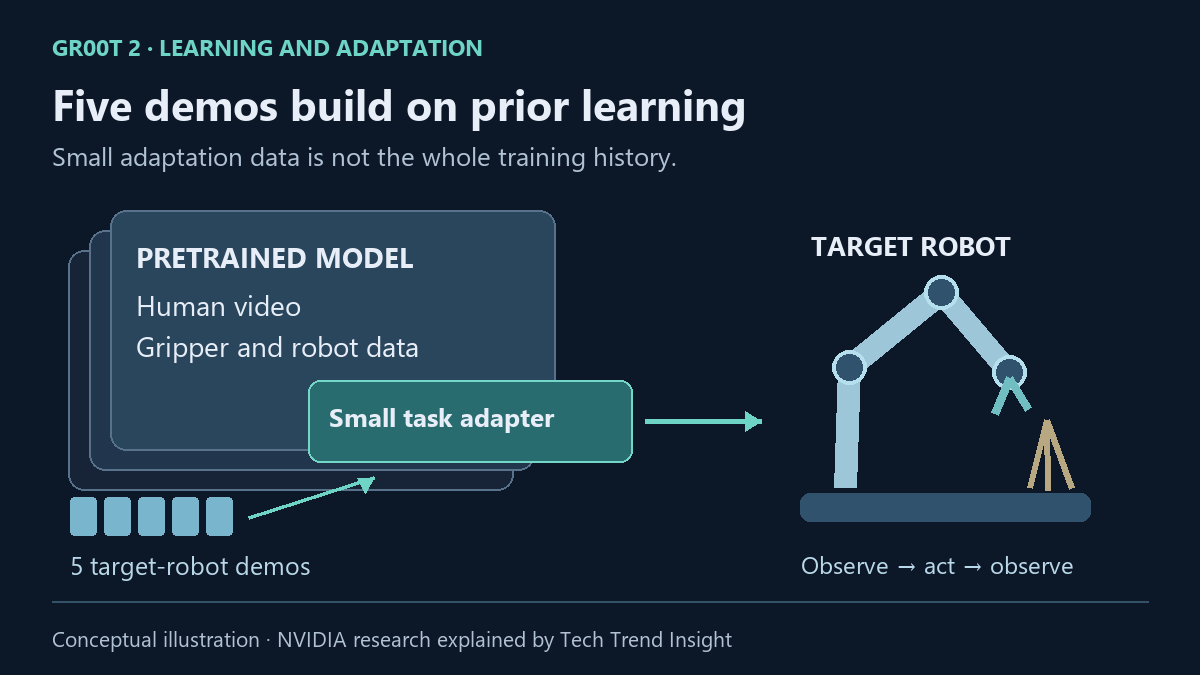
Five demonstrations come after extensive pretraining
A robot policy is software that turns observations and an instruction into commands for a robot. Pretraining builds a broadly useful starting model; adaptation adjusts that model for a more specific job.
GR00T 2 is not an untrained policy learning robotics from five examples. NVIDIA’s research page describes pretraining on 402,730 hours of first-person human video, 10,184 hours of handheld-gripper demonstrations, and 23,500 hours of robot teleoperation, where a person operates the robot to collect examples.
These recording hours describe different sources of experience. Human video can show how a scene changes when somebody grasps or moves an object, but it does not directly supply the joint commands for a particular robot. The target robot still needs a way to connect that visual knowledge to its own body.
The five demonstrations are therefore adaptation data, not the model’s complete training history. In this experiment, zero-shot means no task-specific demonstrations from the target robot. It does not mean no prior exposure to the task anywhere: the test tasks appeared in human video, another robot’s data, or both.
The model predicts a next view as well as a movement
NVIDIA calls GR00T 2 a world-action model: it jointly predicts future camera views and robot actions. The whitepaper’s input/output description gives the basic loop:
- Observe: receive recent camera images, the current robot state, such as joint positions, and a written instruction.
- Predict: produce future camera frames together with a short sequence of actions, called an action chunk.
- Act: the robot’s controller executes that sequence while the system prepares the next chunk.
- Observe again: new camera and state readings provide evidence of what actually happened.
For an instruction such as “Unfold the tripod,” the instruction supplies the goal; the camera views locate the object and its current shape; the robot state describes its starting configuration. The action chunk supplies a short stretch of movement rather than a complete, guaranteed solution.
The predicted future image is a model output, not a camera recording of a successful action. That distinction matters when inspecting a demonstration: a plausible imagined outcome and a completed physical task are different kinds of evidence.
What changed when NVIDIA added demonstrations
The target system was Dexter, a two-arm robot with dexterous hands. NVIDIA adapted the model using one or five teleoperated episodes for each task. It trained LoRA adapters, small sets of additional parameters, while keeping the main pretrained weights fixed. This changes a limited part of an experienced model rather than starting training again.
NVIDIA reports less than three minutes of robot data for the five demonstrations of each task, followed by about 30 minutes of adapter fine-tuning on one RTX 5090. Those timings describe the reported setup. They are not a complete installation time or a budget for another robot.
Figure 1 compares trial success on the same selected task set. It is useful evidence of improvement within that set; it does not measure every task a future owner might want.
Selection does not erase the increase from zero to five demonstrations on matched tasks. It changes the population to which the 95% average applies. A useful next experiment would also count difficult tasks that fail the five-demonstration threshold, rather than leaving them outside the reported group.
Two other results answer different questions. NVIDIA says 40 of the 50 tasks succeeded at least once without target-task demonstrations: that is task coverage, not 80% trial reliability. After five demonstrations, 37 tasks succeeded in every evaluated trial. That describes the observed finite test, not a guarantee of failure-free operation.
How to judge whether this helps your robot
The practical question is how much task-specific collection the pretrained model removes from a deployment. Before comparing a future pilot with the headline result, write down:
- The body and observations: which robot, hands, cameras and state signals are used?
- The demonstration budget: are the examples from this robot, another machine or human video, and is preparation time included?
- The full task list: were tasks chosen before adaptation, or selected afterward for being learnable?
- The success rule: what counts as completion, how many attempts are made, and are retries or human interventions counted?
Record failures as well as successes. A task that works once can be valuable research evidence while still being unsuitable for unattended work. Safety around people, recovery from errors, maintenance and integration cost need their own assessment; a completion-rate chart does not answer them.
What developers can do now
As checked on November 10, NVIDIA’s research page says “Code Available in December,” without a specific day. The research result should not be presented as an already downloadable GR00T 2 setup.
When the release arrives, check the actual checkpoint, license, supported robot hardware, demonstration format, adaptation recipe and evaluation instructions before planning reproduction. Until then, the useful preparation is a well-defined task and evaluation plan, not an assumption that collecting five clips completes the job.
GR00T 2’s important idea is the combination of broad prior experience with a small amount of target-robot adaptation. The open question for an adopter is where that small-data advantage holds when the robot, task list and working conditions are their own.