AI Technical Articles
What Google’s Fuse Study Shows About Asking AI to Read Intent
If you ask an AI assistant what another person “really meant,” its answer may reveal as much about how you told the story as about the interaction itself.
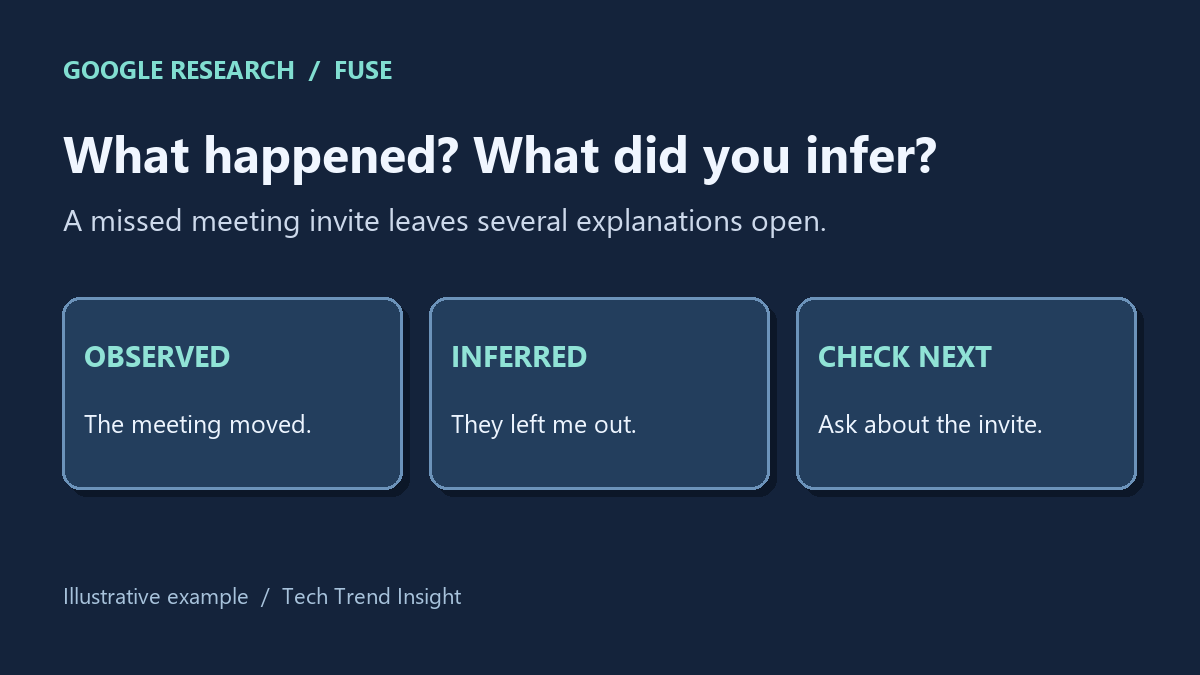
Google Research tested this problem with Fuse, a benchmark built from simulated conversations. Its results suggest a useful change in how to ask for advice: have the assistant sort what happened, what you inferred and what you can check next.
What the assistant actually hears
Imagine you find out that a recurring project meeting moved from Tuesday to Thursday and that you never received the updated calendar invite. You ask an assistant, “Why is my team trying to leave me out?” The meeting date and the missing invite are details you can check. The claim that the team wanted to exclude you is an interpretation you added to the question.
The assistant is working from your account of the situation. It cannot look at the organizer’s calendar, see who received the update or ask the team about the change unless you supply that information or explicitly give it relevant access. The question can sound specific while leaving the evidence incomplete.
How Fuse gives the researchers a known answer
Real disagreements rarely come with a checkable answer about someone’s intentions. Fuse gives a simulated character a specific motive before the interaction takes place. After the scene, a simulated user recounts events to the assistant. The researchers then check whether the assistant’s prediction matches the motive they assigned.
The researchers evaluated 12 language models. In a comparison condition, the model received the simulated events directly and predicted the motive from those events. Performance was better when models had direct access to the events. When the researchers kept the events fixed and changed how the simulated user framed them, model performance also changed. This lets the study distinguish lost context from the effect of a biased account more directly than a collection of real-world advice chats could. Fuse paper, results and analysis
The paper reports about 21,000 dataset examples and 24,000 human annotations across two validation studies. Those annotations helped check whether human readers could recover the assigned motives from the test material. The benchmark uses deliberately constructed scenarios, so its error rates cannot tell you how often an assistant misreads intent in an actual workplace or relationship. Google published its explanation on November 25, 2026. Fuse preprint · Google Research summary
Ask a question that leaves room for missing evidence
Fuse also found that longer conversations did not consistently improve accuracy. If the conversation keeps circling around “they wanted me out,” the extra turns can repeat the same premise. Instead, ask the assistant to point to the evidence for each explanation and identify what would change the assessment. The following prompt is an editorial example outside the scope of the Fuse study.
“List the events I reported and the assumptions I added. Give two or three plausible explanations and say which details support each one. Tell me what information is missing. If several explanations fit, leave the motive open. Suggest one low-stakes way to check a missing fact.”
In the meeting example, the organizer may have worked from an outdated guest list, the invitation may have failed to arrive, or the agenda may have changed. The same missing invite fits all three. An updated guest list or a direct reply from the organizer would help distinguish them. An answer that calls exclusion certain based on the missing invite alone has skipped that check.
Choose a next step that works under several explanations
A short question such as “I saw the meeting moved to Thursday. Am I still on the invite list for the project update?” can resolve the scheduling issue and produce new information. It works whether the cause was a calendar error or a change in who needs to attend. If you learn that the guest list changed, you can ask how responsibilities or updates will work from here.
When an assistant supplies a confident explanation, try one final check: what new fact would make this explanation more likely? If the answer only repeats your original suspicion, you still have a question to investigate.