Code Lab
Headroom Explained: Context Compression Before the AI Model Call
CODE LAB · PROJECT SPOTLIGHT
Headroom Python · Apache-2.0
Explore Headroom’s context compression, token accounting and actual Python source, with practical limits for AI coding workflows.
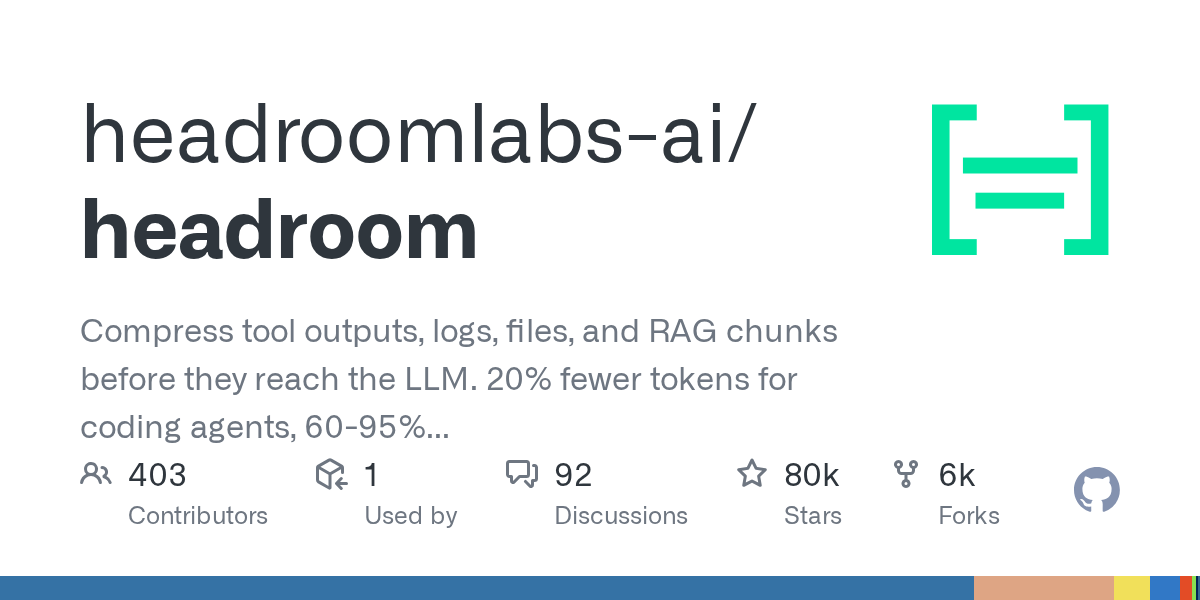
Preview: headroomlabs-ai/headroom on GitHub
A coding agent can spend much of its input budget reading repeated log lines, structured results and files. Headroom places a compression layer before the model call, aiming to reduce that input while preserving the information needed for the task.
The project supplies Python and JavaScript integration paths, including a proxy and SDK wrappers. Its README describes different handling for logs, JSON, code and other content. That distinction matters: repeated records offer different compression opportunities from a short paragraph whose every sentence carries useful information.
This source-and-documentation review was checked November 13, 2026. Project-supplied images and reported results are attributed below; no new hands-on benchmark is claimed.
What does Headroom do?
Imagine an agent investigating a failing build. A tool returns thousands of lines, most describing successful steps. Headroom can transform the material before it enters the next request. A useful evaluation asks whether the agent still identifies the same failure, cites the right evidence and proposes a correct fix. A smaller request alone does not answer those questions.
Inside the source: measure the transformation
The CompressResult fields keep the returned messages alongside before-and-after token counts and a list of applied transforms. These fields make it possible to record what compression changed. They do not establish that the answer preserved its meaning; that requires an evaluation of the downstream task.
Source: headroomlabs-ai/headroom at 9f2cc01. License: Apache-2.0. Original lines retained; syntax colors and line numbers added for this article.
Getting started with a bounded task
Start with the pinned README and the installation path for your client. Decide whether traffic passes through a local proxy and which provider receives the transformed request. Run a small, repeatable task with compression enabled and disabled, keeping the model, prompt and tool output constant. Record input tokens, output quality, latency and total billable usage rather than estimating savings from one percentage.
Limits and what to verify
The repository publishes measurements for particular scenarios. Savings vary with the input and configuration, and a reduction in input tokens is not automatically the same reduction in total cost. Compression can also consume local resources or add latency. Preserve an original copy of important evidence so a suspicious result can be traced back to what the tool actually returned.
Where it fits in your workflow
Headroom is most interesting as an observable step in an agent pipeline: collect input, transform it, measure the change and verify the answer. Compare it with T3 Code’s agent interface to distinguish the environment that runs a task from the layer that prepares its context.
Related Code Lab: T3 Code and AI coding-agent interfaces. For the source-review format used here, see our Lichii repository walkthrough.
Official references: Repository · README at reviewed revision · Release history · Source excerpt.