AI Technical Articles
Shirudo Explained: How Temporary Linux Shields Fit Into Patching
Cisco and OpenAI’s Shirudo offers a qualified answer to an important security question: AI can help create a temporary defense while a permanent patch is being prepared, without giving the AI unrestricted authority to change a running server.
The practical question for a Linux operator is whether that temporary shield can block risky behavior, preserve normal service and be removed cleanly after patching. Each of those needs its own evidence.
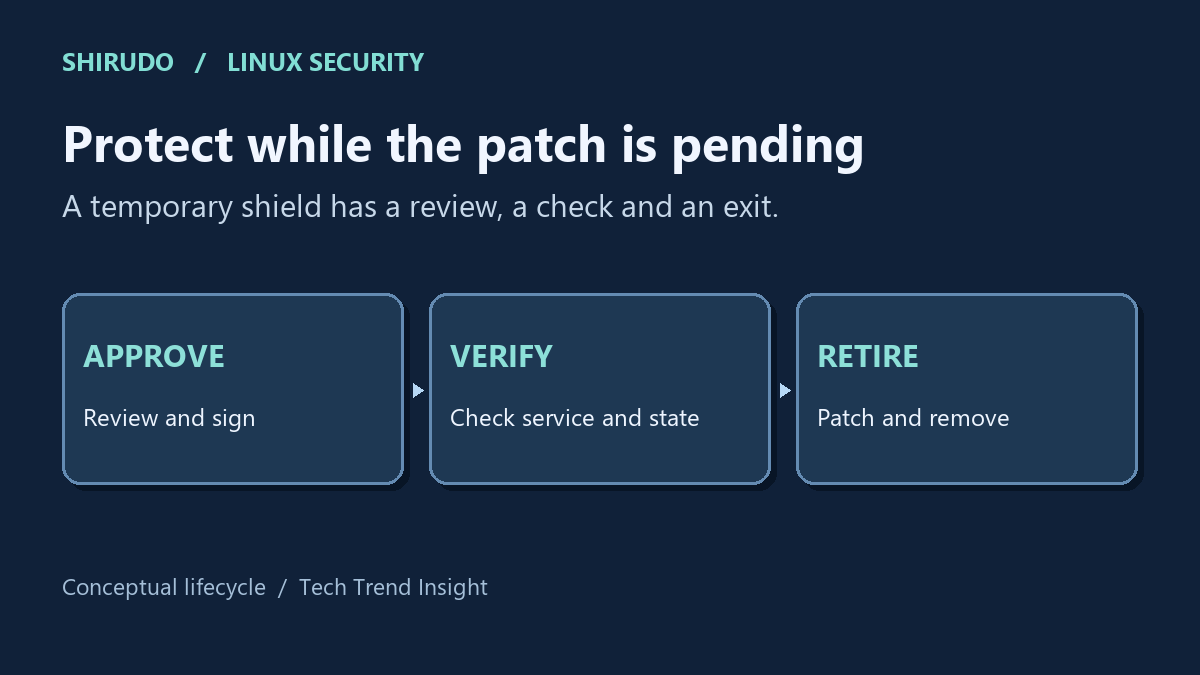
What a temporary shield changes
A patch fixes or updates the affected software. A shield changes what the running system allows while the affected software is still in place. Say a service needs an operating-system operation for normal work, but the same operation can also be reached through unsafe behavior. A broad deny rule might break the service. A narrower rule can help if it reliably distinguishes the behavior the team wants to stop from the work users need to do.
Shirudo uses eBPF, a Linux technology that runs small programs at defined points in the operating system. That gives operators a place to observe behavior and, at supported points, enforce a rule. Cisco and OpenAI describe monitoring a proposed shield’s effects before enforcement and deploying approved shields to running systems. The November 23, 2026 announcement describes a controlled demonstration on a running Elasticsearch service that continued without a restart. That vendor result applies to the configuration tested. It does not establish coverage or performance for other workloads.
OpenAI’s launch announcement · Cisco’s project announcement
Three checks answer three different questions
- Who authorized the load? On an initialized Shirudo target, the Linux kernel checks the loader’s signature against configured trust before it admits the loader. If an AI helped write a candidate shield, the operator still controls which artifact gets signed and authorized for deployment.
- Can the program load safely under the kernel’s rules? Linux’s eBPF verifier checks each program as it loads. Passing that check says nothing about whether the shield blocks the intended behavior or mistakenly rejects ordinary requests.
- What state can the host substantiate? Shirudo records load and unload events. A Trusted Platform Module (TPM) signs evidence an operator can check against the expected measurements. This helps verify the recorded deployment state. Testing the service itself is how the team checks whether the shield is useful.
A digital signature helps prevent unauthorized substitutions. It does not prove that a shield implements the right security policy. The same distinction applies to signatures on an authorized removal. Shirudo architecture and shield lifecycle
What to check before relying on a shield
Use a test system that represents the kernel, application and ordinary traffic you plan to protect. Start with the expected service behavior and decide in advance which evidence would justify enforcement. A team could use these checks:
- Service behavior. Compare successful requests, error rates and response times with the shield observed or enforced against the baseline. For example, if health checks stay green but authenticated users start seeing errors in a routine workflow, the rollout needs more investigation.
- Coverage. Define the behavior the interim control is meant to deny. Record which service versions and hosts were evaluated and what remains outside the shield’s scope. A successful observation on one host cannot establish fleet-wide coverage.
- Deployment and rollback. Confirm that the intended artifact is present where expected, and that the on-call team can authorize removal and verify that removal happened. If the shield changes service behavior unexpectedly, the team needs both a recovery path and a way to check that recovery worked.
This is a proposed evaluation, not a deployment we tested. It distinguishes three decisions that can otherwise blur together: whether the shield’s behavior is acceptable, who may activate it and whether it is active on a particular host.
Give a temporary control an owner and an end date
Keep the permanent patch in the remediation plan, with an owner and a due date. After applying it, confirm the installed version and repeat ordinary service checks. Then retire the temporary shield when verification supports removal. That keeps a short-term exception from becoming an undocumented dependency.