Code Lab
Ponytail Explained: Smaller Complete Changes for AI Coding Agents
CODE LAB · PROJECT SPOTLIGHT
Ponytail Markdown · MIT
Explore Ponytail’s coding instructions, reuse-first approach and actual skill source, with a careful reading of its benchmark claims.
Preview: DietrichGebert/ponytail on GitHub
AI-generated code can solve the requested problem while introducing more machinery than a project needs. Ponytail is a set of instructions that asks a coding agent to look for a smaller complete solution and reuse what the codebase already provides.
The repository centers on agent skills rather than a replacement editor or model. The core skill describes how to approach coding work, choose among existing helpers and dependencies, and keep a change understandable. It also defines different levels of behavior. Those instructions influence a compatible host agent; they are not an independent compiler or correctness checker.
This source-and-documentation review was checked November 13, 2026. Project-supplied images and reported results are attributed below; no new hands-on benchmark is claimed.
What does Ponytail do?
Imagine a request to add one validation message to a form. Before creating a new wrapper or installing another package, inspect the existing validation component and error conventions. Make the change where its callers expect it, then check the relevant behavior. The useful goal is a complete fix with a small review surface, including any callers or fixtures that genuinely need updating.
Inside the skill: reuse the existing implementation
This line comes directly from the core Markdown skill. It asks the agent to use an existing helper, component, service or pattern in the way surrounding code already does. It is an instruction excerpt, not executable program logic. Its effect depends on whether the host agent reads the repository accurately and follows the instruction.
Source: DietrichGebert/ponytail at 96608e0. License: MIT. Original lines retained; syntax colors and line numbers added for this article.
Source credit and MIT license notice
MIT License

Copyright (c) 2026 DietrichGebert

Permission is hereby granted, free of charge, to any person obtaining a copy
of this software and associated documentation files (the "Software"), to deal
in the Software without restriction, including without limitation the rights
to use, copy, modify, merge, publish, distribute, sublicense, and/or sell
copies of the Software, and to permit persons to whom the Software is
furnished to do so, subject to the following conditions:

The above copyright notice and this permission notice shall be included in all
copies or substantial portions of the Software.

THE SOFTWARE IS PROVIDED "AS IS", WITHOUT WARRANTY OF ANY KIND, EXPRESS OR
IMPLIED, INCLUDING BUT NOT LIMITED TO THE WARRANTIES OF MERCHANTABILITY,
FITNESS FOR A PARTICULAR PURPOSE AND NONINFRINGEMENT. IN NO EVENT SHALL THE
AUTHORS OR COPYRIGHT HOLDERS BE LIABLE FOR ANY CLAIM, DAMAGES OR OTHER
LIABILITY, WHETHER IN AN ACTION OF CONTRACT, TORT OR OTHERWISE, ARISING FROM,
OUT OF OR IN CONNECTION WITH THE SOFTWARE OR THE USE OR OTHER DEALINGS IN THE
SOFTWARE.
Getting started with a bounded task
Read the current skill and select the integration supported by your agent. Try it on a bounded task with a known expected result. Compare the resulting diff, behavior and review effort with your usual workflow. Preserve project-specific security, accessibility and validation requirements when deciding whether a shorter implementation is actually sufficient.
Limits and what to verify
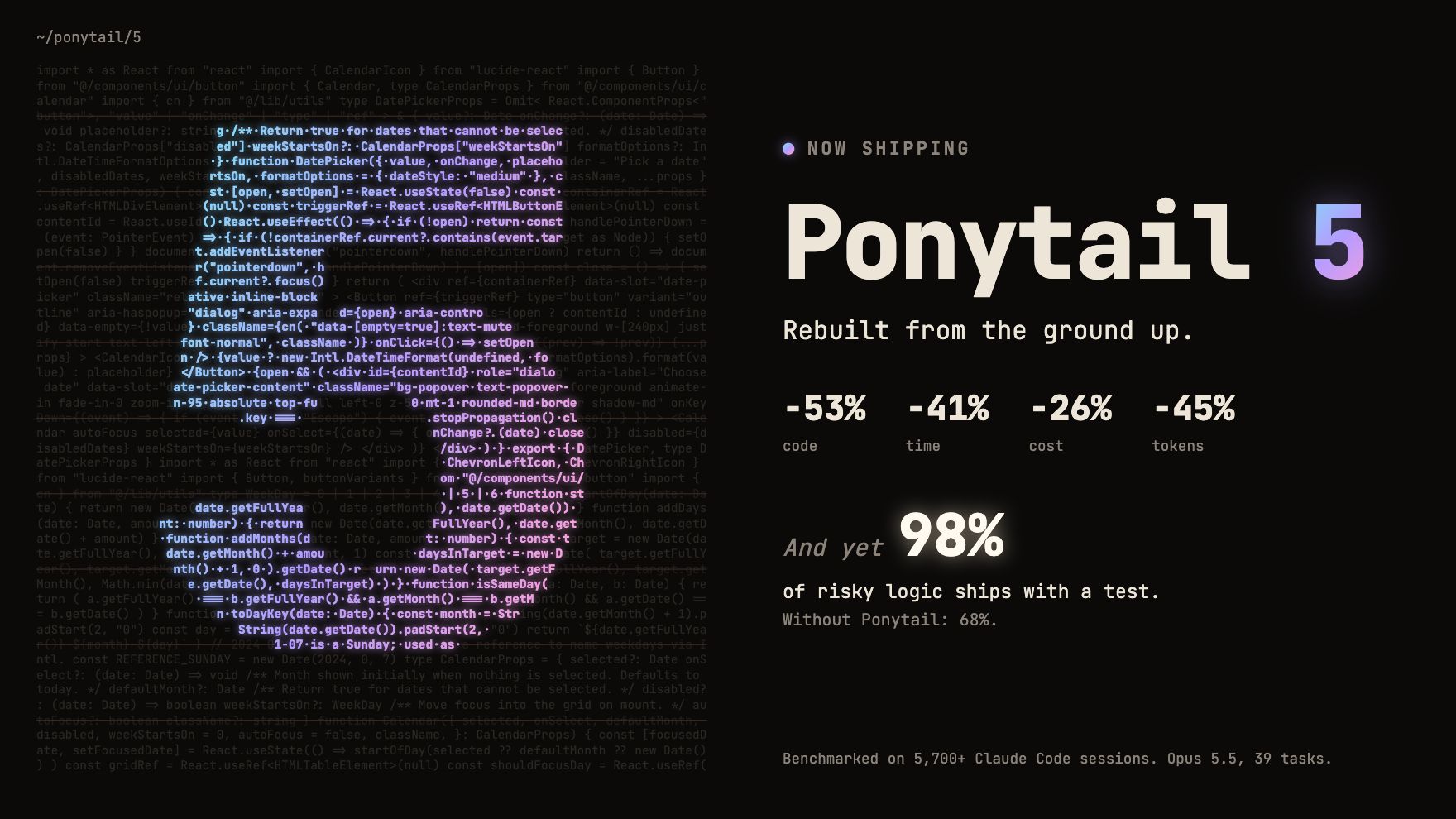
The README publishes benchmark results, including reduced code and cost under specified conditions. These are the maintainer’s measurements and do not guarantee the same result on your model or repository. Fewer lines can improve clarity, but an overly compressed solution can be harder to maintain. Evaluate the finished behavior, not only the diff size.
Where it fits in your workflow
Ponytail provides a useful review question: what existing capability already solves this request? Pair that question with concrete acceptance criteria and normal code review. For a host environment in which coding agents work, see T3 Code.
Related Code Lab: T3 Code and AI coding-agent interfaces. For the source-review format used here, see our Lichii repository walkthrough.
Official references: Repository · README at reviewed revision · Release history · Source excerpt.